GUANGZHOU, China, May 12, 2026 /PRNewswire/ -- TCL CSOT, a global leader in advanced display technologies and a subsidiary of TCL Technology, held a topping-out ceremony for its Gen 8.6 Inkjet-printed OLED (IJP OLED) production line in Guangzhou, China, known as the t8 project. With the completion of the main factory structure and the cleaning work, the world's first Gen 8.6 IJP OLED production line has entered its next critical phase of development.
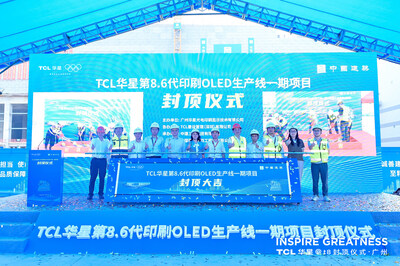
Key Milestone Reached: Project Enters New Stage
As a strategic initiative, the t8 project drives TCL CSOT's next-gen display layout and IJP OLED industrial scaling. With a total investment of US$4.34 billion (RMB 29.5 billion)[1] and a monthly capacity of 22,500 glass substrates, the project achieved remarkable efficiency. Following its groundbreaking on Nov. 30, 2025, the main structure was completed in just 151 days—setting an industry record for the fastest topping-out and epitomizing TCL CSOT's efficiency.
Dr. Weiran Cao, Chief of the IJP OLED Center at TCL CSOT, said, "Our early completion honors our team's dedication. As the world's first mass-production Gen 8.6 IJP OLED line, t8 secures our leadership in the next-gen display industry."
Following the topping-out, the project will enter the comprehensive stages of finish work, power-system installation, and core-equipment relocation.
Deepening Technological Accumulation: A New Engine for Industrial Upgrading
With 13 years of R&D experience in IJP OLED technology, TCL CSOT has built a full end-to-end production system. The Wuhan G5.5 IJP OLED line in China, known as t12, achieved mass production and product delivery in November 2024, providing mature experience and optimized yields necessary to drive the t8 project forward efficiently.
As the world's first mass-production Gen 8.6 IJP OLED line, the t8 project utilizes inkjet-printing processes to precisely deposit organic light-emitting materials onto 2290×2620mm Gen 8.6 glass substrates via "on-demand deposition." Compared to traditional vacuum evaporation, IJP OLED offers superior material utilization, higher yields, and eco-friendly production. Targeting the high-end mid-size display market—including mobile, desktop, TV and automotive displays—this project bolsters premium supply and marks TCL CSOT's transition from pilot R&D to advanced manufacturing.
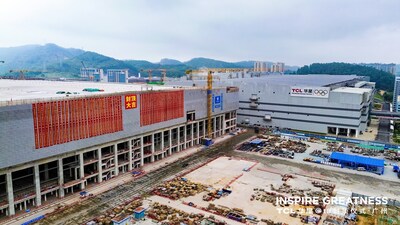
Looking ahead, with the completion and activation of the t8 project, TCL CSOT will gradually build an OLED product portfolio covering multiple sizes and scenarios. By leveraging cutting-edge technologies and premium products, TCL CSOT aims to deliver the ultimate display experience to global users.
[1] Note: This conversion is based on a rate of approximately 1 CNY = 0.1470 USD. |
Photo - https://mma.prnewswire.com/media/2977828/1.jpg
Photo - https://mma.prnewswire.com/media/2977769/2131151636.jpg
 View original content:https://www.prnewswire.co.uk/news-releases/tcl-csot-successfully-tops-out-t8-project-ahead-of-schedule-accelerating-mass-production-of-ijp-oled-technology-302769431.html

Im Land Bremen beginnt nach den Sommerferien ein Pilotprojekt, das den Arbeitsalltag von Lehrkräften grundlegend verändern könnte. An neun ausgewählten Schulen erfassen die Lehrerinnen und Lehrer künftig ihre gesamte Arbeitszeit digital – weit über die bisher dokumentierten Unterrichtsstunden hinaus. Bildungsenator Mark Rackles (SPD) spricht von einem Schritt, der Schule "perspektivisch" verändern werde. Erste Auswertungen des Testlaufs werden für Ende 2027 oder Anfang 2028 erwartet.
Hintergrund ist die gewachsene Bandbreite an Aufgaben, die im bisherigen System kaum abgebildet wird. Neben Unterricht kommen Elternarbeit, Team- und Gremienarbeit, Konferenzen, Schulentwicklungsprojekte sowie Fahrten hinzu. Lehrkräfte berichten zudem von regelmäßigem Arbeiten am Abend oder am Wochenende, etwa für Vorbereitung, Korrekturen oder digitale Kommunikation mit Eltern und Schülerinnen und Schülern. Nach Ansicht des Senats soll diese Belastung künftig sichtbar und systematisch erfasst werden.
Technisch setzt Bremen auf ein digitales Tool, auf das Lehrkräfte per Smartphone oder Rechner zugreifen können. Sie tragen Datum, Uhrzeit und Art der Tätigkeit ein – zur Auswahl stehen Kategorien wie "Unterricht", "Coaching" oder "Austausch"; auch Abwesenheiten durch Krankheit oder Urlaub werden eingepflegt. Das Projekt ist auf ein gesamtes Schuljahr angelegt. In einer Einführungsphase lernen Lehrkräfte die Anwendung kennen, anschließend analysieren Projektgruppen erste Ergebnisse und suchen insbesondere mit stark belasteten Lehrkräften das Gespräch, um gegebenenfalls Anpassungen vorzunehmen.
Politisch und arbeitsrechtlich geht es um mehr als ein Softwareprojekt. Nach einem Urteil des Bundesarbeitsgerichts von 2022 müssen alle Arbeitnehmerinnen und Arbeitnehmer – und damit auch Lehrkräfte – ihre Arbeitszeit erfassen. Der Bremer Testlauf soll daher grundsätzliche Fragen klären: In welchem Umfang ist Wochenendarbeit zulässig? Wie wird eine Klassenfahrt bewertet? Wie lassen sich Teilzeitmodelle, Datenschutz und Gestaltungsspielräume bei der Arbeitszeit unter einen Hut bringen? Rackles betont, das Vorhaben sei nicht nur für Bremen gedacht, sondern solle Erkenntnisse für alle Bundesländer liefern.