LG Reinforces Technology Leadership with IVI and SDV Technologies Delivering Seamless Multi-Display Experiences and Optimized Single-SoC Performance
News Summary
SEOUL, South Korea, May 28, 2026 /PRNewswire/ -- LG Electronics (LG) showcased its latest suite of in-vehicle infotainment (IVI) and software-defined vehicle (SDV) solutions, which earned strong recognition from Google and global automakers.
Showcasing LG's AAOS-Based Innovations
A new range of solutions is built on Android Automotive OS (AAOS) and AAOS SDV technologies. While AAOS SDV enables software to define and control core vehicle functions from driving performance and convenience features to safety systems, AAOS serves as the foundation for delivering infotainment experiences to passengers.
Enabling Seamless Multi-Display Experiences with a Single SoC
A key element is a new solution for simultaneously controlling multiple in-vehicle displays. Powered by Qualcomm Technologies' next generation Snapdragon® Cockpit Platform, LG's solution offers clear, vibrant images and smooth, stable performance enabling a seamless experience across navigation, vehicle information, and entertainment.
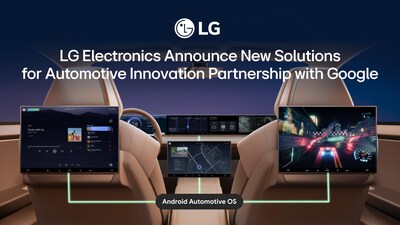
Unlike conventional in-vehicle display systems, which require a separate control chip for each screen, LG's AAOS-based solution can simultaneously control multiple displays with different aspect ratios using only a single system-on-chip (SoC). Leveraging LG's efficient resource allocation technology and system load optimization capabilities, the solution supports automakers to significantly reduce the cost of deploying multi-display in-cabin systems.
Delivering Personalized and Intuitive In-Cabin Experiences
LG's technology allows each person in the vehicle to view different content at the same time. For example, the driver can use navigation on the main display while the front-seat passenger watches YouTube, and the rear-seat passengers enjoy live TV content on their respective screens. The solution also supports individual user login accounts, personalized settings, content sharing and parental controls, enabling a more customized and flexible in-cabin entertainment experience for every passenger.
Additionally, LG has enhanced its voice command-based user interface to provide easier control in large panoramic dashboard environments. With simple spoken commands, users can adjust screen layouts, control key vehicle functions, launch apps and manage system volume. The reduced need for touch interaction contributes to improved convenience and safety in-cabin.
Strengthening Collaboration With Google for the SDV Era
Google executives commended LG's solution for its stable performance, differentiated user experience and ability to support cluster and media entertainment functions through a single SoC.
The solution also received a favorable evaluation for its flexibility in various SoC environments, its potential suitability for a wide range of automotive applications, and its broad chipset compatibility. The positive response reaffirmed the strength of LG and Google's partnership and signaled further opportunities for collaboration.
"LG's solution clearly demonstrated how AAOS can enable more flexible, intelligent and engaging in-vehicle experiences," said Patrick Brady, vice president of Android Automotive at Google. "Its seamless multi-display integration, intuitive voice controls and stable performance powered by a single SoC stood out, and we look forward to continuing our collaboration with LG to advance innovation for the SDV era."
"We are honored that our technological expertise and commitment to customer experience innovation have been recognized," said Eun Seok-hyun, president of the LG Vehicle Solution Company. "Through continued collaboration with Google and other major global tech partners, LG will continue to deliver differentiated in-vehicle customer experiences."
About LG Electronics Vehicle Solution Company
The LG Vehicle Solution Company (VS) is bringing LG's unique mobility innovations to the automotive industry. As a trusted and innovative partner, the company provides intelligent solutions including head units, displays, connectivity, ADAS vision systems, and software solutions integrating human-centered AI and automotive engineering into the modern AI/software-defined vehicle. Committed to "Driving better future mobility," the company has diversified its portfolio to further strengthen its capabilities, including automotive lighting systems, e-powertrain and cybersecurity. For more information, visit www.LG.com/global/mobility. To stay updated with the latest news, subscribe to the LG mobility newsletter, LG Loop at www.LG.com/global/mobility/newsletter and follow the LG VS Company LinkedIn channel at www.linkedin.com/company/lgvehiclesolution.
Photo - https://mma.prnewswire.com/media/2988506/LG_Google_GAPB_2026_MUMD_demo_F.jpg
 View original content:https://www.prnewswire.co.uk/news-releases/lg-electronics-announces-new-solutions-for-automotive-innovation-partnership-with-google-302783807.html

Die Zukunft des deutsch-französischen Panzerprojekts MGCS gerät zunehmend ins Wanken. Armin Papperger, Vorstandschef des Düsseldorfer Rüstungskonzerns Rheinmetall, schließt einen Rückzug Frankreichs aus dem Vorhaben nicht mehr aus. In einem Interview mit der „Welt am Sonntag“ sprach er von einem „Gefahrenszenario“, betonte allerdings, dass bislang keine endgültigen Entscheidungen gefallen seien. Die Diskussionen kommen zu einem Zeitpunkt, an dem mit dem Ende des Kampfflugzeugprojekts FCAS (Scaf) bereits ein anderes zentral geplantes Vorzeigeprojekt der Verteidigungskooperation zwischen Berlin und Paris gescheitert ist.
Nach Informationen Pappergers plant Frankreich, das Budget für das „Main Ground Combat System“ (MGCS) drastisch zu kürzen. Im Gespräch ist demnach ein Ansatz von weniger als der Hälfte der ursprünglichen Planungen. Zwar unterstrich der Rheinmetall-Chef, dass es „null Entscheidungen über das finale Budget“ gebe, doch ein reduzierter Finanzrahmen hätte nach seiner Einschätzung unweigerlich die Streichung von Leistungsumfängen und weitere Verzögerungen zur Folge. „Wenn man weniger Geld zur Verfügung hat, wird man nicht schneller, und wir sind jetzt schon sehr langsam“, sagte er. Bereits jetzt liegt das Programm, das seit rund einem Jahrzehnt läuft, weit hinter den ambitionierten politischen Ankündigungen zurück.
Das MGCS-Projekt wurde auf Initiative der Regierungen Frankreichs und Deutschlands gestartet, um ein gemeinsames, plattformübergreifendes Bodenkampfsystem zu entwickeln, das ab etwa 2040 die Kampfpanzer Leopard 2 und Leclerc ersetzen soll. Beteiligt sind neben Rheinmetall der französische Technologiekonzern Thales sowie KNDS – ein Zusammenschluss des deutschen Herstellers Krauss-Maffei Wegmann und des staatlichen französischen Rüstungsunternehmens Nexter. Trotz der politischen Bedeutung des Vorhabens sind die finanziellen Mittel bislang überschaubar: Die vier Partnerunternehmen haben in rund zehn Jahren zusammen lediglich 25 Millionen Euro erhalten, was Papperger als „offensichtlich sehr wenig Geld“ bezeichnete.
Parallel zum schleppend verlaufenden MGCS treiben Rheinmetall und KNDS Deutschland auf deutscher Seite bereits eine Zwischenlösung voran. Der in der Militärfachpresse inoffiziell „Leopard 3“ genannte neue Kampfpanzer soll nach aktueller Planung Anfang der 2030er Jahre in Dienst gestellt werden und damit die Lücke überbrücken, bis ein mögliches MGCS-System verfügbar wäre. Für MGCS selbst wird die Einsatzreife derzeit erst in den 2040er Jahren erwartet – ein Zeithorizont, den Papperger als „eine Wahnsinnszeit“ bezeichnete. Vor diesem Hintergrund stellte er die grundsätzliche Realisierung des Projekts offen in Frage: „Ich kann heute nicht sagen, ob es überhaupt ein MGCS geben wird.“ Die jüngsten Budgetüberlegungen in Paris verstärken diese Unsicherheit und nähren Zweifel daran, ob Europa den angestrebten gemeinsamen Panzer der Zukunft tatsächlich auf die Spur bringen kann.