SINGAPORE, March 16, 2026 /PRNewswire/ -- As AI becomes an everyday part of travel planning, one thing is increasingly clear: while the technology may be global, how travellers use it is anything but uniform. New data from TripGenie, Trip.com's AI travel assistant, reveals that three years of real-world usage have surfaced new patterns in how travellers plan, decide and navigate their journeys.

What began as a functional tool has evolved into a trusted end-to-end travel companion, and in doing so, has revealed how culture, geography and travel habits shape the role AI plays across the travel journey.
Cultural Differences in AI Use
AI usage shows that planning rhythms vary significantly by market, reflecting unique travel behaviours. For instance, travellers from Hong Kong, Singapore, Malaysia, Italy and France use AI the most during their travel experience.
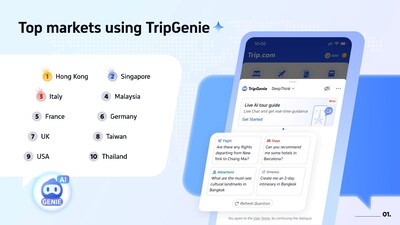
Data shows that travellers in highly connected, short-haul travel markets tend to interact with TripGenie more often per trip, relying on it as a real-time decision-making partner. This includes pre-hotel bookings, attraction guides, and in-destination inspiration, reflecting the fast-paced travel styles seen in markets like Hong Kong, Singapore and Malaysia.
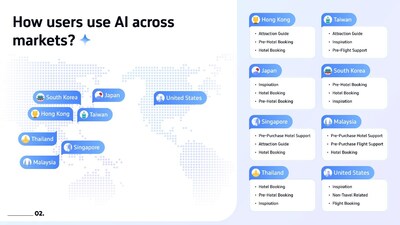
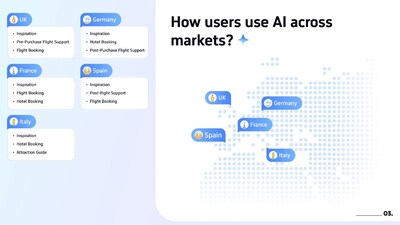
In contrast, travellers in parts of Europe and North America typically engage AI earlier in the planning cycle. In markets such as Germany and the United Kingdom, planning windows are longer and more deliberate, with travellers consulting TripGenie weeks in advance. Most of these inquiries are for flight and hotel products, helping to reduce risk and provide reassurance before booking.
Decision speed also varies sharply. For example, travellers in South Korea and Taiwan often finalise hotel bookings just days before departure, with AI supporting decisions surrounding location and nearby amenities. While a general trend across Asia, Japan is an exception, with travellers typically booking accommodation weeks in advance, reflecting a preference for certainty and early confirmation.
Southern European markets such as Italy, France and Spain sit between these two ends of the spectrum, displaying moderately spontaneous booking behaviours.
Using AI across the Travel Journey
Travellers increasingly use AI across multiple stages of their journey, with TripGenie data showing that users are moving from broad exploratory questions to focused booking and itinerary-related decisions, signalling that AI is becoming an integral part of travel planning.
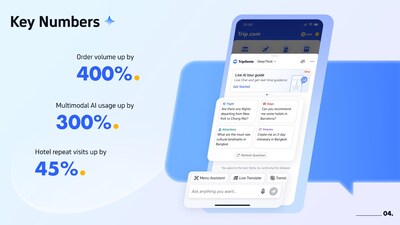
TripGenie AI-assisted order volume on Trip.com increased by around 400% year-on-year, indicating a deeper reliance on AI for inspiration and bookings.
Use of core TripGenie tools, such as hotel comparison, menu assistance, and live translation, increased by around 300% year-on-year, signalling that travellers now use AI as a reliable tool across a trip, rather than a one-off search feature.
Moreover, pre- and post-sales service inquiries now account for around a quarter of all interactions. Travellers are increasingly comfortable relying on TripGenie to handle nuanced, real-world scenarios, from itinerary changes to in-destination questions.
AI: A Trusty Guide for Smart Decisions
As travel decisions become more complex, AI helps travellers reduce uncertainty at every step, from exploring options and asking questions to choosing with confidence.
Nearly 60% of TripGenie interactions are now booking-related, spanning hotels, flights and attractions. Travellers frequently ask practical questions to seek reassurance: Does this hotel meet their needs? Is the location safe? Does this travel policy apply?
Moreover, beyond conversational interaction, users also progress to compare travel options, such as TripGenie's hotel comparison feature, which streamlines the process and reduces the number of clicks needed by 80%, and fosters higher engagement with a 45% increase in 7-day AI revisit rates.
How Travellers Use AI Across Key Travel Products
When it comes to travel, three basic things are needed: a flight, somewhere to stay and something to see. But how AI is used across these products differs greatly.
Flights: AI has become a useful tool to clarify concerns. Over half of travellers frequently consult AI to confirm lounge eligibility, baggage rules and premium services before booking. This is because such information is often scattered across airline websites, credit card terms and fine print, making it time-consuming to interpret without AI assistance.
Accommodation: AI reduces risk by verifying facilities, distances and suitability across a wide range of accommodation types. Among users who used TripGenie's hotel comparison tools, over half selected a hotel that directly matched the AI's recommendation. By allowing travellers to quickly confirm policies and property details that would otherwise require cross-checking multiple sources or contacting hotels directly, AI helps reduce booking uncertainty.
Attractions: Attractions-related queries are increasingly centred on cultural moments, unique experiences, and overall tourist value. Many turn to AI for real-time inspiration, asking what to do today, which experiences are worth their time, or how to explore a destination like a local. This reflects AI's strength in providing contextual and narrative-driven insights, helping travellers understand the cultural meaning and experiential value behind attractions
Beyond Text: The Rise of Multimodal AI Travel
As travel unfolds in real time, travellers are increasingly engaging with TripGenie beyond text alone. Globally, a growing share of users now upload images to support their queries, from menus and street signs to landmarks, hotel rooms and transport information. Revisit rates among these users remain high, with a 7-day revisit rate twice that of the platform as a whole.
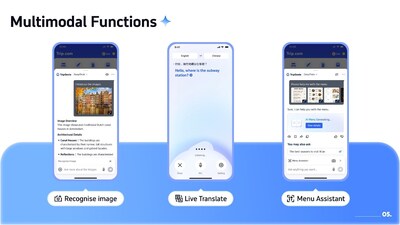
This shift reflects how travellers experience the world: visually, intuitively and often in unfamiliar environments. Notably, users who engage with image-based interactions show significantly higher short-term revisit rates than the platform average, signalling strong satisfaction and deeper trust.
Despite different use patterns, one thing remains consistent: across markets, TripGenie supports local travel behaviour rather than reshaping it. Whether supporting long-term planners or last-minute decision-makers, Trip.com's AI adapts seamlessly across the travel journey, reinforcing its position as a globally available yet locally nuanced travel companion.
(end)
About Trip.com
Trip.com is an international one-stop travel service provider, available in 24 languages across 39 countries and regions in 35 local currencies. Offering an extensive hotel and flight network of more than 1.5 million hotels and flights from over 640 airlines, along with over 300,000 attraction and tour products, Trip.com covers 3,400 airports in 220 countries and regions. Trip.com's world-class 24/7 multilingual customer service helps to 'create the best travel experience' for its millions of customers worldwide. To book your next trip, visit Trip.com.

Photo - https://mma.prnewswire.com/media/2933137/1.jpg
Photo - https://mma.prnewswire.com/media/2933130/2.jpg
Photo - https://mma.prnewswire.com/media/2933131/3.jpg
Photo - https://mma.prnewswire.com/media/2933132/4.jpg
Photo - https://mma.prnewswire.com/media/2933133/5.jpg
Photo - https://mma.prnewswire.com/media/2933134/6.jpg
Logo - https://mma.prnewswire.com/media/1802535/trip_com_Logo.jpg
 View original content:https://www.prnewswire.co.uk/news-releases/three-years-of-tripgenie-how-travellers-around-the-world-are-using-ai-differently-302713205.html

Unmittelbar vor Beginn der Leipziger Buchmesse 2026 gerät die Kulturpolitik des parteilosen Kulturstaatsministers Wolfram Weimer in den Fokus. In Sachsen sorgt der von Weimer verfügte Stopp des geplanten Erweiterungsbaus der Deutschen Nationalbibliothek (DNB) in Leipzig für scharfe Kritik. Die kulturpolitische Sprecherin der Linken-Fraktion im Sächsischen Landtag, Luise Neuhaus-Wartenberg, warnt vor einem drohenden Verlust von rund sieben Millionen Euro, die bereits in die Planung des Projekts geflossen seien. Die DNB hatte zuvor darauf hingewiesen, dass die Magazinkapazitäten am Leipziger Standort nahezu ausgeschöpft seien.
Weimer hatte den Ausbau mit dem Hinweis gestoppt, dass künftig die Digitalisierung stärker in den Mittelpunkt rücken müsse. Aus Sicht der Linken greift diese Begründung zu kurz. Neuhaus-Wartenberg betont, Digitalisierung sei zwar wichtig, könne aber die dauerhafte Sicherung gedruckter Medien, insbesondere von Büchern, nicht ersetzen. Der Schritt sei kultur- wie haushaltspolitisch nicht nachvollziehbar und komme für Leipzig als Buch- und Bibliotheksstandort zur Unzeit – wenige Tage vor der Eröffnung der Buchmesse.
Auch auf der Messe selbst steht der Kulturstaatsminister im Zentrum der Aufmerksamkeit. Weimer hält traditionell die Eröffnungsrede und wird zu einem Rundgang sowie zu einer Diskussionsrunde über Meinungsfreiheit erwartet. Parallel dazu läuft eine Debatte über seine Entscheidung, die Verleihung des Deutschen Buchhandlungspreises abzusagen, nachdem zuvor drei linke Buchläden von der Nominierungsliste gestrichen worden waren. Die Buchmesse-Leitung bedauerte die Absage der Preisverleihung, verweist jedoch darauf, dass sie an dieser Entscheidung nicht beteiligt war. Vor dem Eröffnungsfestakt am Mittwochabend ist zudem eine Demonstration angekündigt; ob es darüber hinaus zu Protesten kommt, bleibt abzuwarten.
Trotz der politischen Spannungen geben sich die Veranstalter der Leipziger Buchmesse optimistisch. Die Schau, die vom 19. bis 22. März ihre Tore öffnet, verzeichnet laut Direktorin Astrid Böhmisch etwas höhere Ausstellerzahlen als im Vorjahr, als 2.040 Aussteller vertreten waren. Gerechnet wird mit rund 300.000 Besucherinnen und Besuchern. Das Programm setzt auf prominente Namen und Reichweite: Von Alice Schwarzer über Sebastian Fitzek bis hin zu Social-Media-Profilen wie Daniela Katzenberger reicht die Bandbreite der angekündigten Gäste. Ein medienwirksames Highlight ist der 18-stündige Lesemarathon von Juli Zehs Bestseller „Unterleuten“, an dem sich Bürger, Politiker, die Messe-Direktorin und die Autorin selbst beteiligen. Die Mega-Lesung wird gestreamt und soll das Publikum weit über die Messehallen hinaus erreichen.
Inhaltlich setzt die Messe 2026 einen geografischen Schwerpunkt: Anstelle eines klassischen Gastlands rückt der Donauraum als Fokusthema in den Vordergrund. Unter dem Motto „Unter Strom und zwischen Welten“ werden dort literarische und kulturelle Perspektiven aus den Anrainerstaaten vorgestellt. Während in den Messehallen die Vielfalt des Programms im Mittelpunkt steht, prägen außerhalb die Entscheidungen des Bundes zur Bibliotheks- und Buchhandlungspolitik die Debatte – und machen Leipzig in diesen Tagen erneut zur Bühne grundlegender Fragen nach Infrastruktur, Kunstfreiheit und dem Selbstverständnis der Buchstadt.