Tencent Cloud's Cube Sandbox goes fully open source with five technical breakthroughs, providing a production-grade foundation for AI Agent deployment at industrial scale.
SHENZHEN, China, April 23, 2026 /PRNewswire/ -- As AI Agent applications evolve rapidly, building an optimal underlying architecture has become one of the industry's most pressing challenges. On April 21, 2026, Tencent Cloud officially introduced its open-sourced Cube Sandbox under Apache 2.0—not SDK-only, but the entire production-grade sandbox-as-a-service stack, battle-tested at scale and immediately deployable.
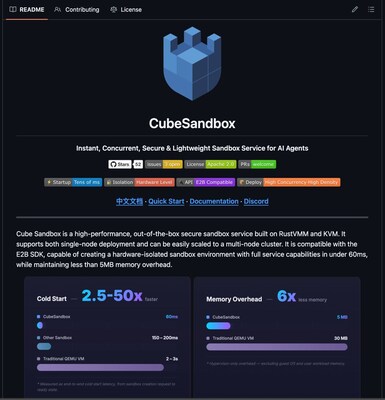
A Foundational Layer for the Agent Era
Cube is the industry's only open-source Agent sandbox combining hardware-level isolation with sub-60ms cold start, natively supporting the OpenAI Python SDK and E2B SDK. Developers can simply redirect the runtime and migrate seamlessly. No code changes required.
This gives developers and enterprises a secure, high-performance, low-cost foundation—bringing Agents from the lab into mass production.
Performance, Security, and Stability at the Limit
Built at the hardware virtualization layer, Cube Sandbox delivers an extreme combination:
Five Breakthroughs: A Hardware-Level Security Cockpit for Agents
Built on MicroVM architecture, Cube addresses autonomous Agent security risks: malicious code execution, data exfiltration, resource abuse, and kernel escape.
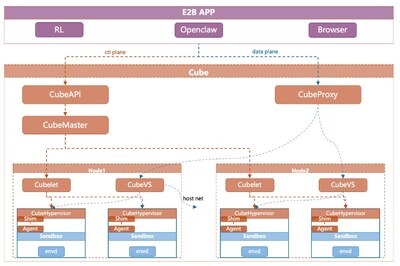
At the technical core, Cube Sandbox delivers five breakthroughs:
Every sandbox runs a dedicated Guest OS kernel via KVM hardware virtualization—no shared kernel. "A breach in one sandbox leaves the rest untouched."
Via resource pool pre-provisioning, snapshot cloning, EPT Lazy Load, and lock optimization, cold start is <60ms (avg. 67ms, P95 = 90ms at 50 concurrent)—significantly outperforming VMs, containers and peer MicroVM solutions.
Per-instance memory overhead <5MB. CoW sharing, Rust-based trimming, and reflink disk sharing enable 2,000+ sandboxes on a single 96-vCPU host, with 90%+ storage savings versus traditional approaches.
Distributed scheduling and bin-packing deliver platform-level burst scheduling of 100K+ instances, with P99 latency below 200ms under 100 concurrent launches on a single 96-vCPU host.
Sub-hundred-millisecond snapshots support checkpoint saving, arbitrary state rollback, and rapid forking. This capability will be released and open-sourced once development is completed.
Three User Scenarios Across the Full Agent Lifecycle
Cube Sandbox addresses the full-lifecycle needs of AI Agents—from R&D and training to application development and enterprise-scale production.
For Foundation Model Labs:
Cube tackles extreme concurrency in Agentic RL training. MiniMax runs hundreds of thousands of heterogeneous sandboxes (Linux, Windows, Android) concurrently. Cube's image acceleration cuts storage and IO pressure; distributed scheduling delivers 100K+ instances per minute, several times faster than peer solutions.
For Agent Developers and Small-to-Medium Businesses:
No Kubernetes, no vendor lock-in—a one-click script sets up the full environment in minutes. Integration via MCP, API, SDK, or CLI requires zero rewrites to Agent code.
For Enterprise Customers:
Full private deployment keeps data within enterprise boundaries, meeting cybersecurity grading and compliance requirements. Apache 2.0 ensures commercial friendliness, full auditability, and zero dependency on foreign cloud providers.
Already Open, Already in Production
Cube Sandbox has released its full codebase, one-click deployment scripts, documentation, and examples—covering Shell execution, file operations, browser automation, RL training, and more—free to use, modify, and distribute.
At the Tencent Cloud Shanghai City Summit on March 27, Dowson Tong, Senior Executive Vice President of Tencent and CEO of the Cloud and Smart Industries Group, first disclosed the Cube open-source plan as a core practice of Tencent Cloud's AI Agent Infrastructure strategy.
Tencent Cloud will pair Cube with TACO AI Acceleration Engine and FlexKV cache system, building a full-stack "Secure Sandbox + Inference Acceleration + Cache Optimization" infrastructure—giving every Agent a secure, efficient, low-cost runtime and unlocking the productivity potential of the large-model era.
Photo - https://mma.prnewswire.com/media/2963963/image1.jpg
Photo - https://mma.prnewswire.com/media/2963962/image2.jpg
 View original content:https://www.prnewswire.co.uk/news-releases/tencent-cloud-cube-sandbox-goes-fully-open-source-with-five-major-breakthroughs-enabling-large-scale-agent-deployment-302751546.html

Quantencomputing entwickelt sich laut einer neuen Analyse von McKinsey & Company vom reinen Forschungsfeld zu einem eigenständigen Wirtschaftszweig. Der „Quantum Technology Monitor 2026“ der Unternehmensberatung verortet das Jahr 2026 als Wendepunkt, an dem Quantenrechner für Unternehmen strategisch relevant werden. Im Mittelpunkt steht nicht mehr nur die technische Machbarkeit, sondern die Frage, welche Firmen jetzt Fähigkeiten und Partnerschaften aufbauen, um sich mit Hilfe der Technologie einen Vorsprung im Wettbewerb zu sichern.
Die Dynamik spiegelt sich in den Finanzierungszahlen wider: Weltweite Investitionen in Start-ups für Quantentechnologien haben sich binnen eines Jahres mehr als verzehnfacht und summierten sich 2025 auf ein Rekordvolumen von 12,6 Milliarden US‑Dollar. Parallel dazu überschritten die globalen Umsätze von Quantencomputing-Unternehmen erstmals die Marke von einer Milliarde Dollar. Damit signalisiert der Markt, dass erste kommerzielle Anwendungen über Pilotprojekte hinausgehen und neue Geschäftsmodelle entstehen.
Technologisch unterscheiden sich Quantencomputer grundlegend von herkömmlichen Systemen. Statt mit Bits, die entweder 0 oder 1 darstellen, arbeiten sie mit Qubits, die dank Superposition Zustände von 0 und 1 gleichzeitig einnehmen können. Hinzu kommt Verschränkung: Qubits können miteinander verbunden sein, unabhängig von ihrer räumlichen Distanz. Diese Eigenschaften ermöglichen es Quantenrechnern, bestimmte Aufgaben wie die Mustererkennung oder die Simulation hochkomplexer Systeme deutlich schneller zu bewältigen als klassische Rechner – mit besonderem Potenzial in Kryptographie, Materialforschung und Künstlicher Intelligenz.
Der McKinsey-Bericht deutet auf einen strukturellen Wandel hin: Quantencomputing ist in den Vorstandsetagen großer Konzerne angekommen. Für Unternehmen wird es zur Managementfrage, wie sie den Zugang zu entsprechender Hardware – häufig über Cloud-Lösungen – sichern, geeignete Software-Stacks aufbauen und zugleich das notwendige Fachwissen ins Haus holen. Der Bericht verweist auf einen sich beschleunigenden internationalen Wettlauf zwischen Europa, den USA und China, der Chancen für etablierte Technologiekonzerne ebenso wie für spezialisierte Newcomer eröffnet. Wer frühzeitig ein Ökosystem aus Partnern und Anwendungen etabliert, dürfte laut Studie die besten Voraussetzungen haben, vom erwarteten Wachstum der Branche zu profitieren.