CLARK, N.J., June 10, 2026 /PRNewswire/ -- GEP Global Supply Chain Volatility Index, based on a monthly survey of 27,000 businesses, signaled continued pressure on global supply chains in May as manufacturers increased purchases and built safety stocks to protect against rising inflation.

Reports of safety stockpiling rose to their highest level since January 2023, as companies bulk ordered goods and raw materials ahead of expected price increases and potential supply disruption. This front-loaded purchasing pushed global demand for inputs to its strongest since March 2022.
Shortages also worsened in May, reaching their highest level in three-and-a-half years. Combined with elevated transportation costs, the data shows that supply chain pressures are no longer limited to shipping and energy markets.
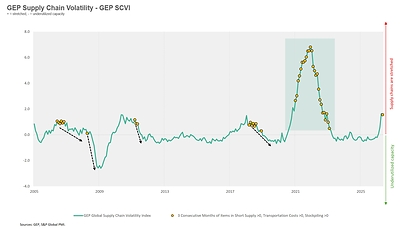
May's data also points to a rare pattern: for three consecutive months, stockpiling, shortages and transportation costs have all been elevated. Outside the 2021-23 supply chain crisis, this has typically been followed by a sharp fall in the index as supply chains self-correct (see chart below), often through weaker input demand or deteriorating economic conditions.
"The path for inflation is already being set, and companies are trying to limit the damage," said John Piatek, vice president, consulting, GEP. "The surge in purchasing we saw in April and May is likely temporary. Once companies have built inventory, they and their customers will pull back, which means supply chain pressures may ease. But, even if the Strait of Hormuz is opened fully, economic conditions will likely weaken in the second half of the year as companies will pull back on their input purchasing to draw down the inventories they've built up."
Interpreting the data:
Index > 0, supply chain capacity is being stretched. The further above 0, the more stretched supply chains are.
Index < 0, supply chain capacity is being underutilized. The further below 0, the more underutilized supply chains are.
MAY 2026 REGIONAL KEY FINDINGS
MAY 2026 KEY FINDINGS
For more information, visit www.gep.com/volatility.
Note: Full historical data dating back to January 2005 is available for subscription. Please contact economics@spglobal.com.
The next release of the GEP Global Supply Chain Volatility Index will be 8 a.m. ET, JuL. 13, 2026.
About the GEP Global Supply Chain Volatility Index
The GEP Global Supply Chain Volatility Index is produced by S&P Global and GEP. It is derived from S&P Global's PMI® surveys, sent to companies in over 40 countries, totaling around 27,000 companies. The headline figure is a weighted sum of six sub-indices derived from PMI data, PMI Comments Trackers and PMI Commodity Price & Supply Indicators compiled by S&P Global.
A Supply Chain Volatility Index is also published at a regional level for Europe, Asia, North America and the U.K. For more information about the methodology, click here.
Media Contacts
Derek Creevey | Joe Hayes | S&P Global Market Intelligence | |
Director, Public Relations | Principal Economist | Corporate Communications | |
GEP | S&P Global Market Intelligence | Email: Press.mi@spglobal.com | |
Phone: +1 646-276-4579 | Phone: +44-1344-328-099 | ||
Email: derek.creevey@gep.com | Email: joe.hayes@spglobal.com |

 View original content to download multimedia:https://www.prnewswire.co.uk/news-releases/safety-stockpiling-hits-highest-level-in-over-three-years-as-businesses-rush-to-protect-against-inflation-and-shortages-gep-global-supply-chain-volatility-index-302794584.html

Das Kiel Institut für Weltwirtschaft (IfW) rechnet trotz der Belastungen durch den Krieg im Nahen Osten weiterhin mit einem leichten Wachstum der deutschen Wirtschaft. In seiner Sommerprognose bestätigt das Institut für das laufende Jahr einen Anstieg des Bruttoinlandsprodukts (BIP) um 0,8 Prozent. Zugleich werden die mittelfristigen Aussichten vorsichtiger eingeschätzt: Für 2027 senkten die Kieler Ökonomen ihre Prognose von bislang 1,4 auf nun 1,0 Prozent.
Als zentralen Belastungsfaktor nennt IfW-Präsident Moritz Schularick die Folgen des Iran-Kriegs. Der Anstieg der Rohstoffpreise erweise sich als hartnäckig und belaste die wirtschaftliche Dynamik voraussichtlich bis ins kommende Jahr hinein. Zu einer ähnlichen Einschätzung gelangt auch das Leibniz-Institut für Wirtschaftsforschung Halle (IWH), das ebenfalls auf den dämpfenden Effekt höherer Energie- und Rohstoffkosten verweist.
Nach Einschätzung des IfW wird die Konjunktur derzeit vor allem von der Finanzpolitik gestützt. Expansive Impulse aus öffentlichen Konsum- und Investitionsausgaben sollen einen Teil der Schwäche in anderen Bereichen kompensieren. Von den traditionell starken Wachstumstreibern der deutschen Wirtschaft – Exporten und Unternehmensinvestitionen – seien hingegen bislang kaum Anzeichen für eine kräftige Erholung zu erkennen, wie sie für frühere Aufschwungphasen typisch gewesen sei. Die Beschäftigungsperspektiven bewertet das Institut entsprechend verhalten.
Zwar hätten sich die Ausfuhren zuletzt stabilisiert, doch spricht das IfW nach den Rückgängen der vergangenen Jahre weiterhin nicht von einer dynamischen Exporterholung. Konjunkturexperte Stefan Kooths warnt in diesem Zusammenhang vor einer schwindenden internationalen Wettbewerbsfähigkeit: Diese Entwicklung dürfte nach seiner Einschätzung weitere Verluste an Weltmarktanteilen nach sich ziehen. Im Vergleich zu früheren Aufschwüngen fielen die erwarteten Zuwächse insgesamt mager aus, und ohne tiefgreifende Reformen zur Stärkung des Standorts drohe die deutsche Wirtschaft in ein Umfeld nachlassender Wachstumskräfte abzugleiten.