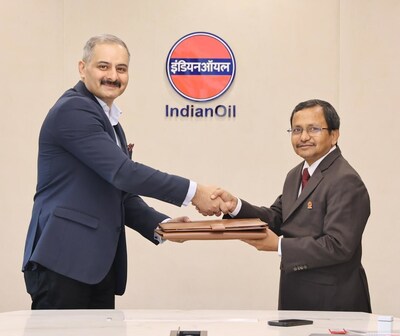
MUMBAI, India, March 13, 2026 /PRNewswire/ -- Re Sustainability has signed an exclusive MoU with Indian Oil Corporation Limited to launch India's first structured national initiative for the collection and recycling of used lubricating oil. The initiative will enable systematic recovery and re-refining of used lubricants, reducing reliance on virgin crude-derived base oils while conserving resources and lowering foreign exchange outflows.
The collaboration will establish a dedicated SPV to build a nationwide reverse logistics and collection network for used lubricating oil. The platform will aggregate lubricants from industrial and automotive sectors and develop Re-Refined Base Oil (RRBO) infrastructure to produce Group I and Group II+ base oils in partnership with Re Sustainability and its technology partners.
Mr. Bankim Patra, Country Head (Lubes), Indian Oil Corporation Limited:
"As India's largest integrated energy company, Indian Oil is committed to advancing solutions that strengthen energy security and environmental responsibility. This collaboration supports the creation of sustainable value chains for responsible recovery, reuse, and circular utilisation of lubricants."
Recovered oil will be processed into Re-Refined Base Oil (RRBO) and reintroduced into lubricant manufacturing. This circular approach reduces reliance on virgin crude-derived base oils and improves resource efficiency across the sector.
Mr. Masood Mallick, Managing Director & Group CEO, Re Sustainability Limited:
"India's journey towards a circular economy requires large-scale systems that can recover value from complex waste streams and reintegrate them into productive use. Our partnership with Indian Oil marks a transformative step towards institutionalising oil recycling at industrial scale in India. By building an integrated ecosystem for used lubricant recovery and re-refining, we are enabling the transition from waste management to resource recovery while strengthening India's environmental infrastructure and circular economy."
The partnership targets an annual collection of 100 KTA of used lubricating oil through a nationwide network of aggregation, logistics, and traceability systems. The initiative will also establish a re-refining facility with a capacity of 50 to 100 KTA of Group II+ RRBO.
It will additionally include recovery and recycling of plastic lubricant containers in line with Extended Producer Responsibility (EPR) regulations.
India generates about 1.3 million tonnes of used lubricating oil annually, but only around 0.2 million tonnes is recovered through formal recycling. This initiative aims to expand formal recovery infrastructure, unlock the value of used lubricants, and support India's transition toward a circular and resource-efficient economy.
Photo: https://mma.prnewswire.com/media/2933434/Re_Sustainability_IOCL_MoU.jpg
Logo: https://mma.prnewswire.com/media/2933433/Re_Sustainability_Logo.jpg
Logo: https://mma.prnewswire.com/media/2933432/IndianOil_Logo.jpg
 View original content:https://www.prnewswire.co.uk/news-releases/re-sustainability-and-indian-oil-join-hands-to-create-indias-first-integrated-used-oil-circular-economy-ecosystem-302713402.html

JD.com startet einen neuen Anlauf in Europa: Der chinesische E-Commerce-Konzern bringt seine Plattform Joybuy offiziell nach Frankreich sowie in fünf weitere Länder – Großbritannien, Deutschland, Belgien, die Niederlande und Luxemburg. Es ist der zweite Versuch des Unternehmens, sich auf dem europäischen Online-Handelsmarkt zu etablieren, nachdem eine erste Joybuy-Version Mitte der 2010er-Jahre, unter anderem im Vereinigten Königreich, nur begrenzte Traktion erzielt hatte und die Ambitionen später zurückgefahren wurden. Diesmal tritt JD.com in ein deutlich reiferes Wettbewerbsumfeld ein, in dem neben Amazon inzwischen auch chinesische Plattformen wie Temu, AliExpress und Shein bei den Verbrauchern fest verankert sind.
Im Gegensatz zu Temu oder Shein setzt Joybuy in Europa nicht auf radikal niedrige Preise und weitgehend unbekannte Marken. Die Plattform positioniert sich näher an Amazon und fokussiert sich auf ein Sortiment etablierter internationaler Marken, ergänzt um lokale Angebote, etwa von französischen Anbietern. Im Techniksegment reicht die Palette von Smartphones – darunter auch einige iPhone-Modelle und vor allem Geräte von Motorola – über Audiozubehör bis hin zu Druckern, Monitoren, Konsolen, Tablets und Videospielen. Joybuy France beschäftigt derzeit rund 300 Mitarbeiter und will sich mit einer Kombination aus Markenbekanntheit und lokal angepasstem Angebot profilieren.
Den Kern der Differenzierung sieht JD.com in der Logistik. Über seine operative Einheit JoyExpress, die im Februar 2026 gestartet ist, verfügt der Konzern nach eigenen Angaben bereits über mehr als 60 Lagerhäuser in Europa, darunter ein Standort im französischen Département Val-d'Oise. Anders als viele Marktplatz-Modelle kauft Joybuy die Ware ein, lagert sie selbst und versendet direkt an die Kunden. Das soll Qualitätskontrolle und schnelle Zustellung ermöglichen. In der Île-de-France wirbt Joybuy mit dem Service „Double 11“: Bestellungen, die vor 11 Uhr eingehen, sollen noch am selben Tag vor 23 Uhr zugestellt werden. Die Same-Day-Option ist vorerst regional begrenzt, kostenlose Lieferung gibt es ab einem Bestellwert von 29 Euro.
Zur Kundenbindung führt Joybuy ein Abo-Modell ein, das deutlich an Amazon Prime erinnert. Das Programm JoyPlus kostet 3,99 Euro im Monat oder 19,99 Euro im Jahr und umfasst unbegrenzte kostenlose Lieferungen sowie ein Punktesystem, bei dem gesammelte Punkte in Einkaufsgutscheine umgewandelt werden können. Mit einer stärker vertikal integrierten Lieferkette, automatisierten Lagerstrukturen und einem auf schnelle Lieferung ausgelegten Netzwerk versucht JD.com, seine in China aufgebaute Logistikexpertise auf Europa zu übertragen. Der Konzern trifft dabei auf einen Markt, der gegenüber chinesischen Unternehmen zunehmend wachsam ist und zugleich von intensivem Preis- und Servicewettbewerb geprägt wird – Bedingungen, unter denen sich zeigen wird, ob Joybuy diesmal dauerhaft Fuß fassen kann.