TAIPEI, July 27, 2026 /PRNewswire/ -- As edge networks grow more complex, SMBs face pressure to deliver enterprise-grade firewall and VPN performance within tight space and power budgets. NEXCOM introduces its new compact gateway, DTA 1600, addressing this gap with high-performance networking in a deployment-friendly platform.
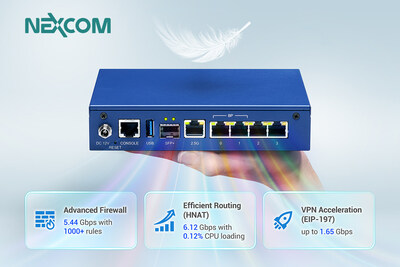
"SMBs face the daunting challenge of securing complex edge networks without the resources of larger enterprises," said Allan Chui, VP of Network and Communication Solutions BG at NEXCOM. "The DTA 1600 bridges this gap, empowering SMBs and ISVs with proven enterprise-grade security that respects their space and power constraints."
Read the full white paper to explore detailed benchmarks and system architecture insights.
Optimized Hardware Design
Powered by the MediaTek MT7988A quad-core processor, the NEXCOM DTA 1600 leverages hardware acceleration for consistent throughput and reduced CPU load. It features a rare 10GbE SFP+ interface for high-bandwidth connectivity, alongside 2.5GbE and 1GbE ports, supporting flexible deployments. For reliability, it integrates TPM 2.0, NEXBOOT™ dual-layer failover, and bypass functionality to ensure network continuity.
Software-Ready, DevOps-Friendly Platform
The platform provides a practical foundation for ISVs and system integrators. With SDK support and a fully brought-up OpenWrt environment, it enables rapid evaluation and customization, reducing development complexity and accelerating time-to-market.
Proven Firewall and VPN Performance
To benchmark real-world operational behavior, a suite of open-source firewall, routing, and VPN frameworks was deployed for rigorous performance validation. The results demonstrate that the DTA 1600 consistently sustains multi-gigabit throughput while maintaining peak system efficiency. Even under intensive workloads, dedicated hardware acceleration mitigates CPU strain, ensuring vital processing resources remain available for higher-layer services and applications.
About NEXCOM
Founded in 1992 and headquartered in Taipei, Taiwan, NEXCOM is shaping the future of AI-powered networking with its software-defined solutions. Through its Network and Communication Solutions (NCS) unit, NEXCOM delivers cutting-edge platforms for Cybersecurity, OT Security, SD-WAN, SASE, Load Balancing, 5G uCPE, edge AI, and more. NCS specializes in professional design and manufacturing services, enabling reliable and scalable network infrastructures for businesses of all sizes. With a focus on innovation, NEXCOM's solutions empower customers worldwide to build resilient, high-performance networks tailored to the demands of tomorrow's connectivity challenges.
Photo - https://mma.prnewswire.com/media/3007681/Cyber_Security_Solutions_DTA1600_PR_2.jpg
 View original content:https://www.prnewswire.co.uk/news-releases/nexcom-unveils-dta-1600-to-solve-smb-network-constraints-with-enterprise-grade-security-302835136.html

Im Streit um die Behandlung sogenannter Heavy User im Mobilfunk hat das nordrhein-westfälische Oberverwaltungsgericht (OVG) die Bundesnetzagentur vorläufig in die Schranken gewiesen. Die Bonner Aufsichtsbehörde hatte einem bundesweit tätigen Mobilfunkanbieter untersagt, Kunden mit unbegrenztem oder sehr großem Datenvolumen bei überlasteten Funkzellen mit geringerer Priorität zu bedienen. Diese Form der sogenannten Depriorisierung darf nach der einstweiligen OVG-Entscheidung vorerst weiter angewendet werden. Der Beschluss im Eilverfahren ist nicht anfechtbar.
Nach Auffassung des 13. Senats ist derzeit offen, ob die entsprechende Vertragsklausel des Anbieters mit europäischem Recht vereinbar ist. Im Kern geht es um die Frage, ob eine nachrangige Behandlung von Vielnutzern eine nicht gerechtfertigte Ungleichbehandlung von Kunden darstellt. Bevor in der Hauptsache entschieden wird, will das OVG Münster den Europäischen Gerichtshof (EuGH) um eine Vorabentscheidung bitten. Damit wird der Konflikt um Datenpriorisierung und Netzmanagement auf die europäische Ebene verlagert.
Gegenstand des Verfahrens ist insbesondere, ob der Datentransport datenintensiver Anwendungen wie hochauflösendem Videostreaming während einer Netzüberlastung eingeschränkt oder verlangsamt werden darf. Der betroffene Mobilfunkanbieter sieht dies in seinen Allgemeinen Geschäftsbedingungen vor, um Kapazitäten in ausgelasteten Funkzellen zu steuern. Die Bundesnetzagentur hatte angeordnet, dass diese Klausel nicht umgesetzt werden darf und damit faktisch einen Riegel vor entsprechende Maßnahmen gegen Heavy User geschoben.
In der Vorinstanz hatte sich die Bundesnetzagentur noch durchgesetzt: Das Verwaltungsgericht Köln hatte die Position der Behörde bestätigt. Das OVG änderte diese Entscheidung nun (Az. 13 B 1232/25) und gab dem Anbieter im Eilverfahren Recht. Mit der geplanten Vorlage an den EuGH dürfte der Fall Signalwirkung für die Auslegung europäischer Vorgaben zur Gleichbehandlung von Internetverkehr und zu den Spielräumen der Netzbetreiber beim Umgang mit stark belasteten Mobilfunkzellen entfalten.