BARCELONA, Spain, March 13, 2026 /PRNewswire/ -- At MWC 2026, Andy Hicks, Senior Principal Analyst for GlobalData, released the white paper Reinventing Voice: A Converged, AI-Enabled, and Multimodal Voice Core for the Next Generation of Telecommunications. The white paper highlights that in the AI era, operators can leverage a fully converged voice network to innovate AI services and redefine the value of voice services.
Fully Converged Voice Network: The Optimal Choice for Operators Managing Multi-Generation Networks
As 5G-A accelerates, the evolution of global network standards remains uneven. Although 2G and 3G networks are reaching their end of life, some operators are required to maintain them to support essential services like M2M communication and international roaming. In this context, a fully converged voice network capable of handling 2G, 3G, 4G, and 5G services is becoming essential for operators. Such a network addresses the operational challenges posed by lifecycle issues and sets the stage for seamless future evolution.
Facing the global shift towards containerization, the fully converged architecture facilitates a smooth transition from VMs to containers. This approach allows operators to lower their TCO while sustaining continuous innovation and agile updates to voice services.
AI + Voice: Transforming Operators' Voice Value in Three Stages
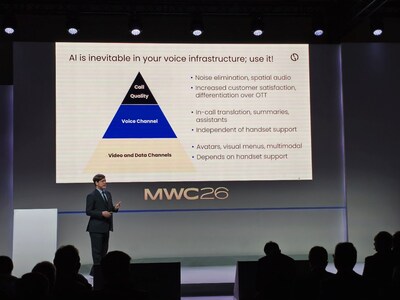
The rapid advancement of AI presents new opportunities for voice service innovation. Andy Hicks believes that the deep integration of AI and voice can be achieved through three key stages.
First, AI is utilized to improve the basic call experience and create a competitive edge over OTT applications. Typical examples include intelligent noise suppression and enhanced spatial audio immersion, elevating calls to a more sophisticated level of communication.
Next, AI is integrated into audio channels to introduce innovative features like real-time translation and intelligent call summaries. These services do not impose additional requirements on terminals. Operators can quickly deploy these services to gain a first-mover advantage in AI-driven voice innovations.
Finally, AI is integrated into video and data channels to advance voice innovation from single-modal to multimodal, enabling services like interactive customer support and healthcare assistants, and realizing the concept of Call-as-a-Service.
Andy Hicks stressed that operators should capitalize on the opportunities presented by AI. By leveraging a fully converged voice network as a foundation, they can foster service innovation and fully rejuvenate the core value of voice services, driven by the dual advancements of 5G-A and AI.
Click to read the white paper: LINK
Photo - https://mma.prnewswire.com/media/2933295/image1.jpg
 View original content:https://www.prnewswire.co.uk/news-releases/mwc-2026-globaldata-releases-a-white-paper-on-voice-evolution-in-the-ai-era-302713235.html

Europa verkleinert im globalen Rennen um die Quantentechnologie seinen Rückstand auf die USA. Nach einer Auswertung des Deutschen Patent- und Markenamts (DPMA) ist die Zahl der veröffentlichten Quanten-Patentanmeldungen aus Deutschland und Frankreich im vergangenen Jahr auf 195 gestiegen. Das entspricht einem Anteil von 23,9 Prozent an allen einschlägigen Anmeldungen. 2021 waren es zusammen erst 57 Anmeldungen mit einem Anteil von 16,7 Prozent gewesen.
Die USA bleiben trotz dieser Verschiebung führend: Sie lagen 2025 mit 167 veröffentlichten Quanten-Patentanmeldungen weiterhin an der Spitze. Ihr weltweiter Anteil ist jedoch im selben Zeitraum von 32,2 Prozent auf 20,5 Prozent zurückgegangen. Neben Deutschland und Frankreich haben vor allem asiatische Staaten ihre Aktivitäten in Forschung und Entwicklung rund um die Quantentechnologie ausgebaut. Insgesamt wuchs die Zahl der veröffentlichten Patentanmeldungen seit 2021 von 341 auf 815.
Im Fokus stehen dabei drei zentrale Bereiche: Hochleistungs-Quantencomputer, abhör- und entschlüsselungssichere Quantenkommunikation sowie hochpräzise Messverfahren der Quantensensorik. Grundlage dieser Technologien sind Quanten, also die kleinsten unteilbaren Einheiten, die physikalische Wechselwirkungen hervorrufen. Aufgrund ihrer besonderen Eigenschaften lassen sich diese Licht- und Energiebausteine für eine Vielzahl von Anwendungen nutzen – von der Rechenleistung über sichere Datenübertragung bis hin zu neuartigen Mess- und Diagnosesystemen.
Die Dynamik in diesem Technologiefeld spiegelt sich auch im Programm des diesjährigen DPMA-Nutzerforums wider: Die Quantentechnologie ist zentrales Thema der wichtigsten Jahresveranstaltung der Münchner Bundesbehörde. Mit dem starken Anstieg europäischer Patentanmeldungen positionieren sich Deutschland und Frankreich stärker in einem Markt, der als strategisch bedeutsam für künftige industrielle Wertschöpfung und technologische Souveränität gilt.