CLARK, N.J., April 10, 2026 /PRNewswire/ -- GEP Global Supply Chain Volatility Index — a leading indicator tracking demand conditions, shortages, transportation costs, inventories and backlogs, based on a monthly survey of 27,000 businesses — signaled that global supply chain pressures rose to a three-year high in March, reflecting the immediate economic impact of the energy price shock and maritime disruption caused by the war in the Middle East.
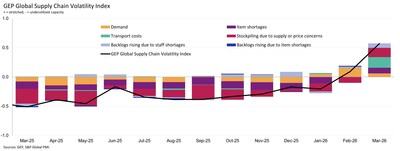
The GEP Global Supply Chain Volatility Index soared from 0.09 in February to 0.57 in March, its highest level since January 2023.
In March, global manufacturers increase safety stockpiling in response to maritime disruption, higher transportation costs and supplier price increases. Reports of inventory buffers being accumulated were the highest in three years, with increases across all major regions.
Uncertainty resulting from the conflict weighed on manufacturers' input demand, with factories around the world cutting purchasing volumes. Notably, item shortages hit a three-year high despite slowing demand, signaling the emergence of bottlenecks, with the availability of materials such as polymers, PVC and rubber, as well as energy-intensive metals such as aluminum and copper reportedly deteriorating the most.
Surging oil prices pushed global transportation costs to a four-year high in March. The impact was felt globally, but especially strongly in Asia, given its reliance on Middle East oil. Taiwan, Vietnam, South Korea and Japan reported surging producer price inflation during March.
"The war is pushing up costs, triggering stockpiling and creating shortages across supply chains, but it has not yet escalated into a broad-based shock that materially slows global economic growth," said Mukund Acharya, vice president, consulting, GEP. "Companies need to secure supply where it matters most while avoiding broad stockpiling that can lock in higher costs."
Interpreting the data:
Index > 0, supply chain capacity is being stretched. The further above 0, the more stretched supply chains are.
Index < 0, supply chain capacity is being underutilized. The further below 0, the more underutilized supply chains are.
Interpreting the data:
Index > 0, supply chain capacity is being stretched. The further above 0, the more stretched supply chains are.
Index < 0, supply chain capacity is being underutilized. The further below 0, the more underutilized supply chains are.
MARCH 2026 REGIONAL KEY FINDINGS
MARCH 2026 KEY FINDINGS
For more information, visit www.gep.com/volatility.
Note: Full historical data dating back to January 2005 is available for subscription. Please contact economics@spglobal.com.
The next release of the GEP Global Supply Chain Volatility Index will be 8 a.m. ET, May 12, 2026.
About the GEP Global Supply Chain Volatility Index
The GEP Global Supply Chain Volatility Index is produced by S&P Global and GEP. It is derived from S&P Global's PMI® surveys, sent to companies in over 40 countries, totaling around 27,000 companies. The headline figure is a weighted sum of six sub-indices derived from PMI data, PMI Comments Trackers and PMI Commodity Price & Supply Indicators compiled by S&P Global.
A Supply Chain Volatility Index is also published at a regional level for Europe, Asia, North America and the U.K. For more information about the methodology, click here.
Media Contacts
Derek Creevey | Joe Hayes | S&P Global Market Intelligence |
Director, Public Relations | Principal Economist | Corporate Communications |
GEP | S&P Global Market Intelligence | Email: Press.mi@spglobal.com |
Phone: +1 646-276-4579 | Phone: +44-1344-328-099 | |
Email: derek.creevey@gep.com | Email: joe.hayes@spglobal.com |
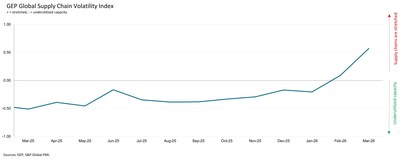
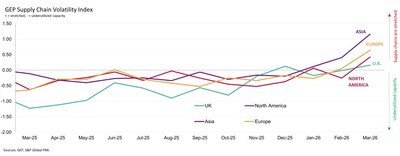

Photo - https://mma.prnewswire.com/media/2953258/GEP_SCVI_breakdown.jpg
Photo - https://mma.prnewswire.com/media/2953259/GEP_SCVI_headline.jpg
Photo - https://mma.prnewswire.com/media/2953260/SCVI_ALL.jpg
Logo - https://mma.prnewswire.com/media/518346/GEP_Logo.jpg
 View original content:https://www.prnewswire.co.uk/news-releases/middle-east-war-drives-global-supply-chain-pressures-to-a-three-year-high-gep-global-supply-chain-volatility-index-302738828.html

Adidas ist mit einem deutlichen Wachstum in das neue Geschäftsjahr gestartet und hat die Erwartungen der Analysten klar übertroffen. Der Sportartikelhersteller steigerte seinen Umsatz im ersten Quartal um gut 7 Prozent auf rund 6,6 Milliarden Euro. Auf währungsbereinigter Basis lag das Plus sogar bei 14 Prozent, wie das Unternehmen in Herzogenaurach mitteilte. Analystenschätzungen, die im Schnitt von rund 6,3 Milliarden Euro ausgegangen waren, wurden damit klar übertroffen. Auch das operative Ergebnis lag mit 705 Millionen Euro über den Prognosen.
Das Unternehmen musste dabei spürbaren Gegenwind durch den starken Euro und Zölle verkraften. Der Währungseffekt belastete den Umsatz nach Unternehmensangaben mit rund 350 Millionen Euro. Dennoch legte Adidas währungsbereinigt in allen Regionen prozentual zweistellig zu – mit Ausnahme von Europa, wo ein Plus von 6 Prozent erreicht wurde. Beim auf die Anteilseigner entfallenden Gewinn verzeichnete der Konzern einen Anstieg um 12,6 Prozent auf 482 Millionen Euro.
Ein wesentlicher Wachstumstreiber war die starke Nachfrage in den eigenen Verkaufskanälen, also in den eigenen Läden und im direkten Geschäft mit Endkunden. Im Großhandel fiel das Plus dagegen verhaltener aus. Vor dem Hintergrund eines unsicheren Konsumumfelds und einer ausgeprägten Rabattschlacht im Einzelhandel verkauft Adidas nach eigenen Angaben bewusst keine „übermäßigen Mengen“ an Handelspartner, um den Preisdruck zu begrenzen – insbesondere im Lifestyle-Segment. Analyst Piral Dadhania von RBC spricht von einer „gesunden Dynamik bei Marke und Umsatz“, die im aktuell herausfordernden und fragmentierten Sportbekleidungsmarkt zunehmend selten sei.
An der Prognose für das laufende Jahr hält der Konzern trotz der Unsicherheiten fest. Adidas rechnet weiterhin damit, den Umsatz währungsbereinigt im hohen einstelligen Prozentbereich zu steigern. An der Börse kamen die Zahlen gut an: Die Aktie legte am Vormittag zeitweise um fast sieben Prozent zu. Damit erhält ein Papier Rückenwind, das zuvor deutlich unter Druck stand – auf Sicht von zwölf Monaten hat der Titel fast ein Drittel an Wert verloren, und im laufenden Jahr liegt die Bilanz bislang im deutlichen Minus. Der bessere Jahresauftakt könnte nach Einschätzung von Marktteilnehmern ein Signal sein, dass der Konzern nach einer schwierigen Phase wieder stabileren Boden unter den Füßen gewinnt.



,regionOfInterest=(1024,613)&hash=407c48b810ef0d4297903e7c5c8fb10e70833f84a9601e8f67fb26ca0598250f)