XI'AN, China, July 29, 2026 /PRNewswire/ -- LONGi is strengthening its commitment to innovation in solar mobility by supporting two of the world's leading solar racing teams at the 2026 Elektrek American Solar Challenge (ASC), one of North America's premier solar-powered endurance competitions. This year's ASC takes competitors from Minnesota to Texas, with much of the route following the historic Route 66 corridor.
Taking place from July 25 to August 1, the ASC challenges teams to cover the greatest cumulative distance over eight days, rather than compete for outright speed. As they traverse diverse climate zones and complex terrain, teams must continuously optimize energy management and strategic decision-making throughout the endurance challenge.
For LONGi, the competition serves as more than a race — it is a real-world platform for validating and advancing next-generation photovoltaic technologies.
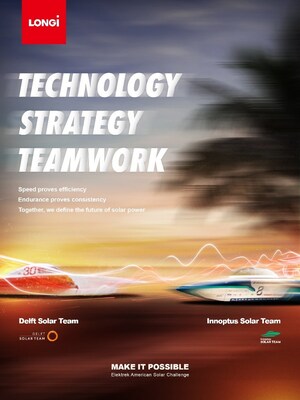
Expanding Partnerships with Two of the World's Leading Solar Racing Teams
Following its collaboration with Belgium's Innoptus Solar Team at the 2025 Bridgestone World Solar Challenge (BWSC), LONGi has further strengthened its technical collaboration within the global solar racing community.
For the 2026 season, LONGi is partnering with both Belgium's Innoptus Solar Team and the Netherlands' Delft Solar Team. Both teams ranked among the top three at the 2025 BWSC and represent the only two European teams competing in this year's Elektrek American Solar Challenge.
The expanded collaboration reflects LONGi's continued commitment to working alongside global innovators to explore the potential of photovoltaic technology through real-world engineering challenges.
High-Efficiency BC Technology at the Core
Solar racing represents one of the most challenging applications for photovoltaic technology. With extremely limited surface area available on the vehicle, every solar cell must achieve maximum conversion efficiency while maintaining reliability under dynamic operating conditions, curved vehicle surfaces, temperature variations, and long-distance endurance challenges.
To meet these requirements, LONGi provides tailored BC (Back Contact) technology solutions for both teams.
Innoptus Solar Team is equipped with LONGi's customized high-efficiency BC flexible modules, specifically designed for the curved surfaces and lightweight architecture of solar race cars. Meanwhile, Delft Solar Team integrates LONGi's high-efficiency BC solar cell strings into its vehicle's energy system.
As the vehicle's sole direct energy source, the photovoltaic system determines how effectively sunlight can be converted into usable power. High conversion efficiency, lightweight design, and operational reliability provide the foundation for innovations in aerodynamics, energy management, and vehicle control.
Technology, Strategy and Teamwork: Making Peak Performance Possible
Achieving peak performance in the Elektrek American Solar Challenge requires more than advanced photovoltaic technology alone. As the foundation of every solar race car, high-efficiency PV technology determines how much energy the vehicle can capture from sunlight and directly influences the power available throughout the journey.
Beyond the photovoltaic system, teams must continuously balance energy management, route strategy, and driving decisions based on changing sunlight conditions, weather patterns, and terrain. Every choice plays a role in maximizing the vehicle's potential and extending its range throughout the eight-day challenge.
Peak performance is also made possible through close collaboration between drivers, engineers, and technology partners. By combining technical expertise, strategic thinking, and teamwork, these collaborations transform innovative concepts into real-world performance.
Through its partnerships with leading solar racing teams, LONGi continues to explore the possibilities of high-efficiency photovoltaic technology in demanding environments, gaining valuable insights that help advance future solar applications.
Driving Innovation Beyond the Race
LONGi's partnerships with leading solar racing teams are built on technical collaboration and co-creation rather than sponsorship alone.
The company views solar motorsport as an innovation platform where advanced photovoltaic technologies can be validated, refined, and further developed under real operating conditions. technology innovation, combining expertise across industries to accelerate breakthroughs in photovoltaic performance.
The value of these partnerships extends beyond the race itself. By working together with engineers, researchers, and innovators around the world, LONGi aims not only to provide advanced solar technologies, but also to foster an open innovation ecosystem where collective insights and collaboration help expand the boundaries of what solar energy can achieve.
As the global energy system evolves toward a more sustainable and integrated future, LONGi remains committed to advancing photovoltaic innovation, strengthening collaboration across the energy ecosystem, and unlocking new possibilities for a cleaner energy transition.

Photo - https://mma.prnewswire.com/media/3008199/image1.jpg
Logo - https://mma.prnewswire.com/media/1606520/LONGi_Logo.jpg
 View original content:https://www.prnewswire.co.uk/news-releases/longi-bc-technology-powers-two-world-leading-solar-racing-teams-at-the-2026-elektrek-american-solar-challenge-302837280.html

Nach gut zehn Monaten Bauzeit ist die stark befahrene Bahnstrecke zwischen Hamburg und Berlin wieder vollständig in Betrieb – allerdings mit sechs Wochen Verspätung gegenüber dem ursprünglichen Zeitplan. Am frühen Morgen fuhr der erste Fernzug um 5.36 Uhr mit leichter Verspätung vom Hamburger Hauptbahnhof in Richtung Hauptstadt ab, wie die Deutsche Bahn mitteilte. Bereits seit Samstagabend nutzen Güterzüge den Korridor, seit Sonntag rollen auch wieder Fern- und Regionalzüge regulär über die sanierte Verbindung.
Für Tausende Pendlerinnen und Pendler entfällt damit der belastende Ersatzverkehr mit Bussen. Während der Generalsanierung war der Fernverkehr über Stendal und Uelzen umgeleitet worden, regionale Verbindungen zwischen Hamburg und Berlin fielen monatelang aus. Schon Mitte Mai hatte die Bahn einen ersten Teilabschnitt entlastet und die durchgehende Verbindung zwischen Hamburg und Schwerin wieder aufgenommen. Nun ist die gesamte Achse zurück im Netz – die Bahn warnt jedoch vor Anlaufschwierigkeiten und empfiehlt, Fahrzeiten vorab zu prüfen.
Die Wiederinbetriebnahme verläuft holprig. Am ersten Betriebstag sammelten sich auf der frisch sanierten Strecke Verspätungen von mindestens 15 Minuten, teils deutlich darüber. Fernzüge benötigten am Sonntag in der Regel mehr als zwei Stunden und 15 Minuten zwischen den Hauptbahnhöfen, obwohl die schnellsten ICE nach Abschluss der Arbeiten eigentlich in rund einer Stunde und 47 Minuten verkehren sollen. Hintergrund ist unter anderem, dass das für Tempo 230 ausgelegte LZB-Zugsicherungssystem auf Teilen der Trasse noch nicht abgenommen ist. Auf diesen Abschnitten gilt vorerst das PZB-System mit einer zulässigen Höchstgeschwindigkeit von 160 Stundenkilometern.
Die Bauarbeiten auf der 2025 begonnenen Generalsanierung umfassten nach Bahnangaben die Erneuerung von 165 Kilometern Gleisen und die Instandsetzung weiterer 61 Kilometer. Zudem wurden 249 Weichen eingebaut und 28 Bahnhöfe modernisiert. Der ursprünglich bis Ende April angesetzte Abschluss verzögerte sich durch einen harten Winter und gefrorenen Boden, der den Zeitpuffer aufbrauchte. Mit der jetzt abgeschlossenen Kernsanierung ist die Verbindung zwischen den beiden größten deutschen Städten infrastrukturell deutlich erneuert, ihre geplante Höchstleistung im Fahrplanbetrieb dürfte aber erst erreicht werden, wenn die technischen Zugsicherungssysteme auf der gesamten Strecke vollumfänglich verfügbar sind.