PROVIDENCIALES, Turks and Caicos Islands, March 15, 2026 /PRNewswire/ -- KuCoin, a leading global crypto platform built on trust, today announced the launch of KuCoin Skills Hub, an evolving open skills marketplace designed to give AI agents broader crypto-native access through standardized, modular capabilities. KuCoin Skills Hub is compatible with mainstream agent frameworks and development environments, helping retail users access crypto through more intuitive natural-language interactions while enabling institutions, developers, and quantitative teams to build automated research, trading, and asset management workflows more efficiently. Rooted in KuCoin's belief that technology should serve people and be built on trusted, transparent infrastructure, the launch marks a further step in modularizing crypto capabilities for practical AI adoption in real-world use cases.
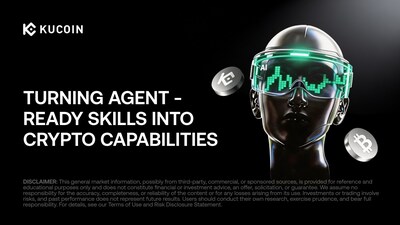
As AI agents evolve from conversational tools into execution-oriented systems, crypto infrastructure must become more accessible, composable, and action-ready. Historically, fragmented tools, complex interfaces, and technical barriers have limited advanced crypto workflows to a relatively narrow group of users. KuCoin Skills Hub is designed to help close that gap by converting complex underlying functions into structured skills that can be accessed more naturally and deployed more broadly.
Trust, security, and execution control remain central to the platform's architecture. KuCoin Skills Hub incorporates safeguards around permission control, credential isolation, sensitive data protection, execution boundaries, and exception handling to support more secure and controllable deployment in real-world environments.
Through natural-language interaction, users can access market insights, monitor signals and market activity, and query exchange data more efficiently through the Skills Hub. Support for deeper interaction scenarios such as wallet operations, on-chain insights, liquidity provision, staking, lending, and yield strategies will be introduced in future releases, enabling a more unified workflow for insight, decision-making, execution, and broader ecosystem participation.
"AI is changing how people interact with the crypto economy, but the real value of technology lies in whether it can serve real users on top of infrastructure they can trust," said BC Wong, CEO of KuCoin. "Built on KuCoin's expanding ecosystem and broader crypto-native AI initiatives, KuCoin Skills Hub is designed to transform complex crypto capabilities into more intuitive, scalable, and usable modules — making crypto more accessible for everyday users while giving institutions and developers a more flexible foundation for the next generation of intelligent applications. We see this as an important step toward a more open, practical, and trustworthy AI-enabled crypto ecosystem."
Looking ahead, KuCoin Skills Hub will continue to expand its skills library, data sources, protocol integrations, and operational capabilities, further strengthening the open infrastructure layer needed for the next phase of AI-enabled crypto innovation.
About KuCoin
Founded in 2017, KuCoin is a leading global crypto platform trusted by over 40 million users across 200+ countries and regions. The platform delivers innovative digital-asset services, offering access to 1,000+ listed tokens, spot and futures trading, institutional wealth management, and a Web3 wallet.
Recognized by Forbes and Hurun, KuCoin holds SOC 2 Type II and ISO 27001:2022 certifications, underscoring its commitment to top-tier security. With AUSTRAC registration in Australia and a MiCA license in Austria, KuCoin continues expanding its regulated footprint under CEO BC Wong, building a reliable and trusted digital-asset ecosystem.
Learn more: www.kucoin.com
Photo - https://mma.prnewswire.com/media/2934123/image_5002362_37993044.jpg
Logo - https://mma.prnewswire.com/media/2785613/KuCoin_new_Logo.jpg
 View original content:https://www.prnewswire.co.uk/news-releases/kucoin-launches-skills-hub-turning-agent-ready-skills-into-crypto-capabilities-302714096.html


In Norddeutschland ist die Zahl der Endometriose-Diagnosen in den vergangenen zwei Jahrzehnten deutlich gestiegen. Das geht aus einer Auswertung der Krankenkasse Barmer hervor, die anonyme Abrechnungsdaten ihrer Versicherten aus den Jahren 2005 bis 2024 analysiert hat. In Hamburg mehr als verfünffachte sich die Zahl der betroffenen Frauen von rund 2.500 auf mehr als 13.800. In Niedersachsen legten die Diagnosen von rund 22.000 auf gut 50.000 zu, in Schleswig-Holstein von etwa 5.000 auf rund 17.000. Mecklenburg-Vorpommern verzeichnete einen Anstieg von rund 3.500 auf mehr als 8.800 Fälle, in Bremen nahmen die Diagnosen von knapp 2.300 auf etwa 3.900 zu.
Die Barmer führt die Entwicklung vor allem auf ein gestiegenes Bewusstsein für die Erkrankung zurück. „Die Entwicklungen zeigen, dass Endometriose inzwischen bekannter ist und Beschwerden schneller ernst genommen werden“, sagte Anneke Riehl, Landesgeschäftsführerin der Barmer in Schleswig-Holstein. Zugleich verweist die Krankenkasse auf deutliche regionale Unterschiede: In dicht besiedelten Räumen werde Endometriose häufiger diagnostiziert als in ländlichen Gebieten. Das deute darauf hin, dass Information und Sensibilisierung nicht überall gleichermaßen greifen.
Endometriose ist eine chronische Erkrankung, bei der Gewebe, das der Gebärmutterschleimhaut ähnelt, außerhalb der Gebärmutterhöhle wächst – häufig am Bauchfell, an den Eierstöcken oder am Darm. Leitsymptom sind Unterleibsschmerzen, die oft rund um die Regelblutung sowie während oder nach dem Geschlechtsverkehr auftreten. Die Erkrankung kann sich negativ auf die Fruchtbarkeit auswirken. Nach Angaben der Barmer sind bei betroffenen Frauen zudem Begleiterkrankungen überdurchschnittlich häufig dokumentiert, darunter Bauch- und Beckenschmerzen, Migräne, Muskel-Skelett-Erkrankungen, depressive Episoden und Angststörungen.
Vertreterinnen der Barmer mahnen weitere Aufklärungsarbeit an. Viele Frauen hielten ihre Beschwerden weiterhin für gewöhnliche starke Regelschmerzen und suchten deshalb nicht frühzeitig ärztliche Hilfe, sagte Heike Sander, Landesgeschäftsführerin der Barmer in Niedersachsen und Bremen. Entscheidend sei zudem, dass sich die Behandlung an der Lebenssituation der Patientinnen orientiere – etwa an der Familienplanung, der Mobilität oder der psychischen Gesundheit. Die deutlich gestiegenen Diagnosezahlen wertet die Kasse daher als Hinweis auf Fortschritte bei der Erkennung der Erkrankung, aber auch auf weiterhin bestehende Lücken in Versorgung und Information, vor allem außerhalb der Ballungsräume.