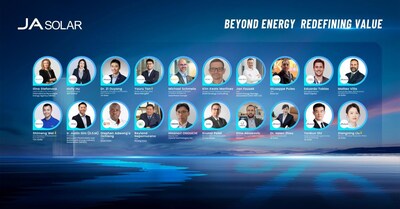
BEIJING, April 21, 2026 /PRNewswire/ -- The 5th Global Solar and Energy Storage Summit 2026, hosted online by JA Solar, brought together over 20+ senior representatives from leading international organizations and industry players to share insights on the accelerating energy transition. The summit featured keynote speeches and panel discussions with influential voices from the IRENA, S&P Global, BloombergNEF, SolarPower Europe, TÜV NORD, as well as prominent utilities, developers, investors, and technology companies worldwide. With a global audience exceeding 20,000 participants from 30+ countries, the event highlighted the growing integration of solar and energy storage as central to a cleaner, smarter, and more resilient energy future.
Record-Breaking Renewable Deployment in 2025
IRENA's Ilina Stefanova opened the summit by underscoring the scale and urgency of the global energy transition. "2025 marked a record year for renewable energy, with 692 GW of new capacity deployed globally, and solar contributing 75% of the total," she said. However, she emphasized the need for stronger policy and investment frameworks to sustain this momentum and meet 2030 climate targets.
S&P Global's Holly Hu followed with the latest market outlook, noting that global solar installations reached 617 GW in 2025, driven by robust activity in China, Europe, and North America. While she acknowledged potential growth moderation in 2026, Hu emphasized an industry shift from scale-dominated competition to smarter, more value-driven strategies.
Solar + Storage + X: The Future of Energy Solutions
Dr. Zi Ouyang, President of Product and Solution R&D Centre and CTO of JA Solar, delivered a keynote on how integrated solutions are shaping the next phase of clean energy deployment. He introduced "Solar + Storage + X" as the industry's path forward, where combined technologies create new opportunities across utility-scale, commercial, and residential markets.
"The future of energy lies in integration," said Dr. Ouyang. "Standalone solar PV systems are no longer sufficient to meet today's increasingly complex demands. By integrating storage and advanced solutions, we can unlock significant value and provide the flexibility necessary for tomorrow's global energy systems." He also highlighted JA Solar's expertise in enabling scenario-specific solutions, including AI-powered data centers, industrial parks, and remote microgrids.
Driving Value Creation Across Global Markets
Two panel discussions explored the changing dynamics of solar and storage integration.
The first, "Global Perspectives: New Value Drivers and Growth Opportunities," discussed the industry's pivot toward value-based development. Panelists emphasized how system efficiency, long-term performance, and financial optimization are replacing cost as priorities, with integrated solutions emerging as critical to capturing project value and market flexibility.
The second panel, "Energy Transformation Across Every Scenario: From Deserts to Cities," explored the application of solar and storage in emerging sectors such as AI Data Centers (AIDC), mining, modern agriculture, and transportation infrastructure. Panelists highlighted innovations addressing diverse energy demands while tackling challenges like system resilience in extreme environments, from remote deserts to urban microgrids.
JA Solar's Global Leadership in Integrated Energy Growth
The summit reflected the industry's transition into a transformative phase defined by integration, intelligence, and scenario diversity. As the event organizer and a leading global innovator in solar technology, JA Solar reaffirmed its commitment to accelerating the adoption of high-performance, sustainable energy solutions.
"At JA Solar, we believe collaboration and innovation are fundamental to building a sustainable energy future," said Dr. Zi Ouyang. "Through advanced technologies and strong partnerships, we aim to deliver scalable, resilient solutions that meet the evolving needs of customers worldwide."
 View original content:https://www.prnewswire.co.uk/news-releases/ja-solar-summit-highlights-shift-toward-solar-storage-integration-as-global-demand-holds-firm-302747994.html

Der Trinkgetränkehersteller Capri-Sun verschärft seine Auseinandersetzung mit der Europäischen Union um den Einsatz von Plastikstrohhalmen – obwohl eine aufwendig beworbene Online-Petition klar hinter den Erwartungen zurückgeblieben ist. Statt der anvisierten einen Million Unterschriften kamen innerhalb von rund eineinhalb Jahren auf der Plattform Change.org weniger als 169.000 zustande. Das Unternehmen bewirbt die Petition nach eigenen Angaben inzwischen nicht mehr aktiv, hält an dem Ziel einer Rückkehr zum Plastiktrinkhalm aber fest.
Ausgelöst wurde der Konflikt durch das seit 2021 geltende EU-Verbot für Einwegplastikprodukte wie Trinkhalme. Capri-Sun musste daraufhin seine klassischen Trinkbeutel auf Papierstrohhalme umstellen, die in Plastik verpackt an den Beuteln befestigt werden. Seitdem reißen die Beschwerden von Kundinnen und Kunden nach Unternehmensangaben nicht ab: Die Papierhalme ließen sich schlechter in die Folie stechen, würden beim Trinken weich und sorgten für einen wahrnehmbaren Papiergeschmack. Capri-Sun hat das Design der Papierhalme zwar mehrfach überarbeitet, sieht die Probleme damit aber offenbar nicht gelöst.
Strategisch setzt der Hersteller nun auf einen technischen Ansatz: Capri-Sun strebt an, künftig sowohl Trinkbeutel als auch Strohhalm aus demselben Kunststoff, Polypropylen, zu fertigen. Das Unternehmen argumentiert, ein einstoffliches System verbessere die Recyclingfähigkeit, weil Beutel und Röhrchen gemeinsam dem gleichen Stoffkreislauf zugeführt werden könnten. Man befinde sich dazu in einem „konstruktiven Austausch“ mit der EU-Kommission, wie Capri-Sun betont. Die Brüsseler Behörde bestätigt Gespräche und verweist darauf, dass das Einwegplastikverbot bis kommendes Jahr überprüft werde. Parallel arbeitet die EU an einer neuen Verpackungsverordnung mit stärkeren Vorgaben zur Recyclingfähigkeit.
Umwelt- und Verbraucherschutzorganisationen reagieren kritisch auf die Vorstöße des Unternehmens und verweisen auf die massive Umweltverschmutzung durch Einwegplastik, die ursprüngliche Grundlage des EU-Verbots. Die Deutsche Umwelthilfe warnt unter anderem vor Mikroplastik in Nahrungsketten. Capri-Sun wiederum sieht sich im Spannungsfeld zwischen regulatorischen Vorgaben, Umweltbedenken und Kundenerwartungen – und versucht, das Verbot nicht grundsätzlich infrage zu stellen, sondern über das Recyclingargument eine Ausnahme oder Anpassung der Regeln zu erreichen. Ob der Polypropylen-Ansatz Brüssel überzeugt, dürfte sich im Zuge der laufenden Überprüfung des Einwegplastikrahmens entscheiden.



,regionOfInterest=(1024,613)&hash=407c48b810ef0d4297903e7c5c8fb10e70833f84a9601e8f67fb26ca0598250f)