SHANGHAI, Oct. 27, 2026 /PRNewswire/ -- Antai College of Economics and Management (ACEM) at Shanghai Jiao Tong University hosted the 11th International Business School Shanghai Conference (IBSSC) at the Xuhui campus from October 21 to 23, drawing over 200 deans, scholars and industry leaders from over 30 countries and regions.
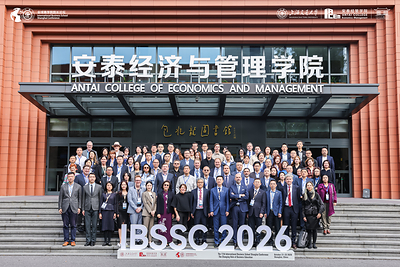
Since 2006, the biennial forum has engaged nearly 700 business schools across 88 countries and regions, welcoming over 3,000 participants, and has grown into one of the world's most influential platforms for business education exchange.
Under the theme "The Changing Role of Business Education," the three-day conference explored how technological disruption, geopolitical shifts and societal change are reshaping business education.
Keynote addresses were delivered by Sarah A. Soule, Dean of Stanford Graduate School of Business; Jun Yang, Dean of Nanyang Business School, Nanyang Technological University; Xuan Tian, Dean of Guanghua School of Management, Peking University; Frederik Anseel, Dean of HKUST Business School; and David Bach, President of IMD (International Institute for Management Development). Together, they underscored a shared conviction: as AI dissolves the scarcity of knowledge, business schools must double down on what machines cannot replicate—human judgment, ethics and cross-cultural competence.
A landmark outcome of the conference was the launch of the U21 Business School Network for Societal Impact. Building on the framework of Universitas 21, the alliance was initiated by ACEM together with the University of Zurich, the University of Auckland, Tecnológico de Monterrey and the University of Queensland. Spanning Asia, Europe, Oceania and North America, it will advance cross-border collaboration in education, research and social service, moving global business education cooperation from dialogue toward institutionalized partnership.
Roundtable dialogues and a journal symposium on academic publishing added further depth to the conference. The event also featured a CEO Forum, where Changwu Zhang, Founder, Chairman and CEO of LandSpace, and Ning Chen, Founder, Chairman and CEO of Intellifusion, shared insights on commercial spaceflight and artificial intelligence. In a special tribute, replicas of manuscripts by pioneering scientist Qian Xuesen were presented to the two entrepreneurs.
Fangruo Chen, Dean of ACEM, said that the challenges facing business education cannot be solved by any single institution alone, and that only through openness and mutual learning can business schools adapt to change and cultivate the next generation of business leaders. He looks forward to reconvening global peers in Shanghai in 2028, writing the next chapter of global business education cooperation.
About Antai College of Economics and Management, Shanghai Jiao Tong University
Antai College of Economics and Management at Shanghai Jiao Tong University is the first business school in the Chinese mainland to be triple-accredited by AMBA, EQUIS and AACSB. Guided by its strategy of "cross-disciplinary integration" and "unity of knowledge and practice," the college is dedicated to cultivating globally oriented business leaders and advancing industry-engaged research and international collaboration.
 View original content to download multimedia:https://www.prnewswire.co.uk/news-releases/ibssc-2026-concludes-in-shanghai-charting-the-future-of-business-education-302920560.html

Im Magdeburger Landtag steht ein Einschnitt in der bundesdeutschen Parlamentsgeschichte bevor: Erstmals könnte ein Abgeordneter der AfD das Amt des Landtagspräsidenten übernehmen. Der 35-jährige Tobias Rausch, seit 2016 Mitglied des Landtags von Sachsen-Anhalt und Generalsekretär der AfD im Bundesland, geht mit einer komfortablen Mehrheit in die konstituierende Sitzung. Nach ihrem klaren Wahlsieg stellt die AfD künftig 39 der 83 Abgeordneten und ist damit die mit Abstand stärkste Fraktion.
Den entscheidenden Schub liefert das Bündnis mit dem Bündnis Sahra Wagenknecht (BSW). Die fünf BSW-Abgeordneten wollen geschlossen für Rausch stimmen und kommen gemeinsam mit der AfD auf 44 Stimmen. BSW-Fraktionschef Thomas Schulze verweist auf parlamentarische Gepflogenheiten: Als stärkste Fraktion habe die AfD laut Geschäftsordnung Anspruch auf den Vorsitz im Parlament. Eine politische Blockbildung gegen die AfD lehnt Schulze ab und präsentiert die Zustimmung zur Wahl des Landtagspräsidenten als Signal eines „neuen Politikstils“.
Die übrigen Fraktionen reagieren gespalten. CDU, SPD, Grüne und Linke verfügen zusammen ebenfalls über 39 Mandate, treten aber nicht geschlossen gegen die AfD an. Die CDU hat angekündigt, sich bei der Wahl zu enthalten – Enthaltungen zählen in diesem Verfahren nicht als abgegebene Stimmen. SPD, Grüne und Linke wollen gegen Rausch stimmen. Spannend bleibt damit vor allem die Frage, ob der AfD-Kandidat über die absehbaren 44 Ja-Stimmen hinaus zusätzliche Unterstützung erhält. Vor der geheimen Abstimmung spekulieren die Lager bereits über mögliche Abweichler; aus der AfD-Spitze heißt es, zusätzliche Stimmen könnten auch aus dem Kreis der erklärten Gegner stammen.
Parallel zur Präsidentenwahl testet die AfD aus, wie weit ihr neuer Einfluss im Landtag reicht. Die Fraktion will die Geschäftsordnung ändern, um neben dem Präsidenten auch einen der drei Vizepräsidentenposten zu besetzen – vorgesehen ist der Abgeordnete Hans-Thomas Tillschneider. In der Vergangenheit sorgten seine Beiträge zur Bildungs- und Kulturpolitik regelmäßig für Kritik in anderen Fraktionen, die den Personalvorschlag daher als Provokation werten dürften. Ob das BSW diese Personalie ebenso mitträgt wie die Wahl von Rausch, ist bislang offen. Unabhängig vom Ausgang der Abstimmungen wird die erste Sitzung des neu gewählten Landtags damit zum Testfall für künftige Zusammenarbeit und Machtarithmetik in Sachsen-Anhalt.




