The multi-year collaboration aims to scale molecular data storage infrastructure and unlock breakthrough cost efficiencies by 2030.
PISCATAWAY, N.J. and LOS ANGELES, April 9, 2026 /PRNewswire/ -- GenScript Biotech Corporation, the world's leading provider of CMOS-based DNA synthesis technologies, and Mimulus Corp, the pioneer in Molecular Archive Technology™, today announced a strategic collaboration to industrialize DNA-based data storage, a technology poised to transform how the world preserves data in the age of Artificial Intelligence.
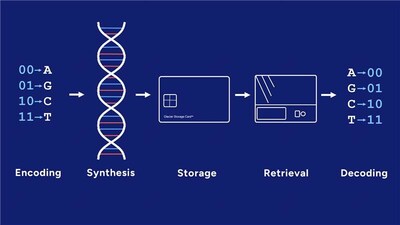
As the AI-driven surge in global data creation accelerates exponentially, existing archival storage systems built on magnetic tape and hard drives are reaching their economic and environmental limits. The strategic partnership between GenScript and Mimulus aims to address this challenge by architecting the world's first molecular archival storage that requires no electricity to preserve data once encoded into DNA and can store massive volumes of information for centuries.
Under the agreement, GenScript will industrialize high‑throughput DNA synthesis at scale, targeting a leap from millions to billions of oligonucleotides synthesized in parallel on a single chip. Building on its highly-validated manufacturing platform, currently capable of synthesizing 8 million oligonucleotides in parallel on a single chip, GenScript will deliver the scale, reproducibility, and validation required to make emerging applications like molecular data storage commercially viable. While the DNA technology landscape remains fragmented across writing, reading, and storage, GenScript brings capabilities across key parts of the DNA data storage value chain, including synthesis, sequencing-related technologies, and platform development. Combined with Mimulus' proprietary Molecular Archive Technology™, this capability enables molecular data storage to transition from laboratory innovation to commercially scalable infrastructure.
"When a new category emerges, the winners are built on infrastructure," said Sherry Shao, Rotating CEO of GenScript Biotech Corporation. "At GenScript, we believe in Scripting Possibilities - turning what was once theoretical into scalable reality. DNA-based data storage will only become a viable real-world infrastructure when synthesis can be delivered at extraordinary throughput, quality, and cost. We are building that industrial foundation to transform molecular storage from being 'scientific promise' into 'global reality'."
Mimulus Glacier Data Storage Card is replacing decaying magnetic infrastructure. By combining GenScript's proven industrial-scale synthesis engine with Mimulus's molecular transcoding architecture, this credit-card-sized device creates a completely off-stack and off-grid physical vault. The collaboration seeks to dramatically accelerate the cost curve of DNA-based storage and unlock economically viable archival systems for global cloud and AI workloads.
"Trying to solve a pressing 21st-century AI data problem with mid-century magnetic tape is a bit like trying to launch a rocket with a steam engine," said Todd R. Nelson, Ph.D., Founder and Chairman of Mimulus Corp. "But this isn't just about building a better storage device; it's about liquidating an operational liability to fuel the AI revolution. By combining our proprietary architecture with GenScript's unparalleled manufacturing scale, we are printing power permits. We are handing hyperscalers the exact megawatts they need to turn on their AI supercomputers today, unlocking a trillion-dollar flywheel that reshapes the economics of the cloud."
About GenScript Biotech Corporation
Founded in 2002 in New Jersey, GenScript Biotech Corporation accelerates innovation in biotech and healthcare by providing researchers and companies with the building blocks needed to develop ground breaking treatments and products. As a cornerstone of the global life science ecosystem, GenScript actively collaborates with a diverse network of partners—from academic institutions to industry leaders—to co-create cutting-edge solutions that redefine service excellence. Guided by its mission to Make People and Nature Healthier Through Biotechnology, GenScript has become a trusted global partner with a team of 6,100+ employees, supporting over 200,000 customers across 100+ countries and regions, including the world's Top 20 pharma companies. For more information: www.genscript.com
About Mimulus Corp
Mimulus Corp is a venture-backed biotechnology company architecting the world's first economically sustainable and physically permanent archival infrastructure for the age of AI. By combining the scaling laws of the semiconductor industry with the density of synthetic biology, Mimulus solves the global archival storage crisis and liberates critical grid power for AI compute. Led by a team of serial entrepreneurs with over $7 billion in capital formation experience, Mimulus is making the future molecular. For more information: www.mimulus.co
Media Contacts:
For GenScript: Melis Inceer, Head of Integrated Communications & Content, melis.inceer@genscript.com
For Mimulus Corp: Colette Patnaude, Founder, press@mimulus.co

Photo - https://mma.prnewswire.com/media/2952816/How_Molecular_Data_Storage_Works.jpg
Logo - https://mma.prnewswire.com/media/2952815/GenScript_Mimulus_Partner_Logo.jpg
 View original content:https://www.prnewswire.co.uk/news-releases/genscript-and-mimulus-partner-to-industrialize-dna-based-data-storage-for-the-ai-era-302737775.html

Quantencomputing entwickelt sich laut einer neuen Analyse von McKinsey & Company vom reinen Forschungsfeld zu einem eigenständigen Wirtschaftszweig. Der „Quantum Technology Monitor 2026“ der Unternehmensberatung verortet das Jahr 2026 als Wendepunkt, an dem Quantenrechner für Unternehmen strategisch relevant werden. Im Mittelpunkt steht nicht mehr nur die technische Machbarkeit, sondern die Frage, welche Firmen jetzt Fähigkeiten und Partnerschaften aufbauen, um sich mit Hilfe der Technologie einen Vorsprung im Wettbewerb zu sichern.
Die Dynamik spiegelt sich in den Finanzierungszahlen wider: Weltweite Investitionen in Start-ups für Quantentechnologien haben sich binnen eines Jahres mehr als verzehnfacht und summierten sich 2025 auf ein Rekordvolumen von 12,6 Milliarden US‑Dollar. Parallel dazu überschritten die globalen Umsätze von Quantencomputing-Unternehmen erstmals die Marke von einer Milliarde Dollar. Damit signalisiert der Markt, dass erste kommerzielle Anwendungen über Pilotprojekte hinausgehen und neue Geschäftsmodelle entstehen.
Technologisch unterscheiden sich Quantencomputer grundlegend von herkömmlichen Systemen. Statt mit Bits, die entweder 0 oder 1 darstellen, arbeiten sie mit Qubits, die dank Superposition Zustände von 0 und 1 gleichzeitig einnehmen können. Hinzu kommt Verschränkung: Qubits können miteinander verbunden sein, unabhängig von ihrer räumlichen Distanz. Diese Eigenschaften ermöglichen es Quantenrechnern, bestimmte Aufgaben wie die Mustererkennung oder die Simulation hochkomplexer Systeme deutlich schneller zu bewältigen als klassische Rechner – mit besonderem Potenzial in Kryptographie, Materialforschung und Künstlicher Intelligenz.
Der McKinsey-Bericht deutet auf einen strukturellen Wandel hin: Quantencomputing ist in den Vorstandsetagen großer Konzerne angekommen. Für Unternehmen wird es zur Managementfrage, wie sie den Zugang zu entsprechender Hardware – häufig über Cloud-Lösungen – sichern, geeignete Software-Stacks aufbauen und zugleich das notwendige Fachwissen ins Haus holen. Der Bericht verweist auf einen sich beschleunigenden internationalen Wettlauf zwischen Europa, den USA und China, der Chancen für etablierte Technologiekonzerne ebenso wie für spezialisierte Newcomer eröffnet. Wer frühzeitig ein Ökosystem aus Partnern und Anwendungen etabliert, dürfte laut Studie die besten Voraussetzungen haben, vom erwarteten Wachstum der Branche zu profitieren.


,regionOfInterest=(1024,613)&hash=407c48b810ef0d4297903e7c5c8fb10e70833f84a9601e8f67fb26ca0598250f)

