SEOUL, South Korea, April 9, 2026 /PRNewswire/ -- Kia Corporation (Kia) today shared its mid-to-long-term business strategies and financial targets at its 2026 CEO Investor Day held in Seoul, Korea.
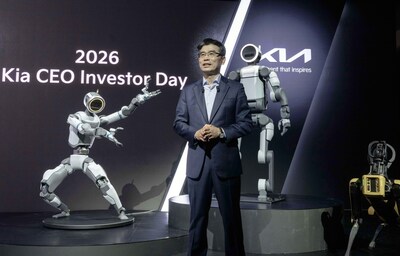
This year's event focused on reviewing the five-year progress of Kia's 'Total Transformation' initiative, following the company's brand relaunch in 2021. Kia also outlined its mid- to long-term growth roadmap across all business sectors.
"Building on the achievements of innovation across all areas over the past five years —including brand, EVs, PBVs, and ESG — EVs, HEVs, autonomous driving, and robotics will serve as key drivers for Kia's fastest growth to date. Even amid the evolving global environment, Kia will proactively respond to changing market conditions through differentiated strategies." – Ho Sung Song, President and CEO of Kia Corporation.
2030 Mid- to Long-Term Business Strategy
Kia aims to pursue a strategy to accelerate exponential growth, targeting global sales of 4.13 million units by 2030 with a 4.5 percent market share. This compares with a sales goal of 3.35 million units with a 3.8 percent market share in 2026.
Kia places customers at the centre of its business strategy and, over the mid- to long-term, the company intends to expand its mobility ecosystem with a strategic focus on PBVs, autonomous driving, and robotics, connecting people and infrastructure to drive enhanced value creation for both customers and wider society.
Overview of Key Announcements at Kia 2026 CEO Investor Day
Category | Content | ||
2030 | Global Sales Targets |
| |
ICE & HEV |
| ||
EV | Sales Target |
| |
Enhancing EV Product |
| ||
Improving EV Accessibility |
| ||
Strengthening |
| ||
PBV |
| ||
Regional | U.S. |
| |
Europe |
| ||
Emerging |
| ||
Future | Autonomous Driving |
| |
Robotics |
| ||
2026 Business Plan & |
| ||
For more information, visit the Kia Global Newsroom.
Photo - https://mma.prnewswire.com/media/2953023/Image_1__2026_Kia_CEO_Investor_Day.jpg
PDF - https://mma.prnewswire.com/media/2953024/Press_release__2026_Kia_CEO_Investor_Day.pdf
 View original content to download multimedia:https://www.prnewswire.co.uk/news-releases/2026-kia-ceo-investor-day-kia-to-drive-exponential-growth-and-manufacturing-innovation-by-expanding-its-full-electrified-vehicle-lineup-and-strengthening-future-business-capabilities-302738080.html

Porsche startet mit einem deutlichen Dämpfer ins Jahr, hält aber an seinen Zielen fest. Der Sport- und Geländewagenbauer setzte im ersten Quartal rund 8,4 Milliarden Euro um, ein Rückgang von etwa 5 Prozent im Vergleich zum Vorjahr. Das operative Konzernergebnis sank um gut ein Fünftel auf 595 Millionen Euro, die operative Umsatzrendite ging von 8,6 auf 7,1 Prozent zurück. Unter dem Strich fiel der Gewinn nach Steuern um rund ein Viertel auf 391 Millionen Euro. An der Börse kamen die Zahlen dennoch vergleichsweise gut an: In einem schwachen Gesamtmarkt legte die Aktie um 1,6 Prozent auf 41,17 Euro zu.
Analysten hatten im Vorfeld bereits mit einem Gewinnrückgang gerechnet, unter anderem wegen des anhaltend schwierigen Umfelds in China und höherer Belastungen in den USA. Im Konsens war von einem Ergebnisminus von etwa 25 Prozent und einer niedrigeren Rendite ausgegangen worden. Citi-Analyst Harald Henrikse hob hervor, dass sich die operative Marge im Kerngeschäft ohne Sonderkosten bei rund 8 Prozent stabilisiere – angesichts des derzeitigen Absatzniveaus sei das bemerkenswert und deute darauf hin, dass Porsche die Talsohle bei der Profitabilität erreicht haben könnte. Jefferies verwies darauf, dass das operative Ergebnis rund sieben Prozent über den Markterwartungen gelegen habe, gestützt durch das Modellmix und eine disziplinierte Preisstrategie.
Das Management führt den Rückgang der Auslieferungen – minus 14,7 Prozent auf 60.991 Fahrzeuge – auf eine gezielte Volumensteuerung zurück. Die Strategie "Value over Volume" priorisiert Margen über Stückzahlen und wird durch eine stärkere Gewichtung renditestarker Modelle wie GT-Varianten untermauert. Gleichzeitig lasten Sondereffekte auf den Zahlen: Finanzchef Jochen Breckner bezifferte die im Quartal angefallenen Sonderkosten für den laufenden Strategiewechsel auf rund 100 Millionen Euro, für das Gesamtjahr werden 800 bis 900 Millionen Euro erwartet. Zusätzlich schlagen höhere US-Importzölle mit etwa 200 Millionen Euro allein im ersten Quartal zu Buche.
Vor diesem Hintergrund bestätigt Porsche seinen Ausblick für das Gesamtjahr. Der Konzern rechnet weiterhin mit einem Umsatz zwischen 35 und 36 Milliarden Euro und einer operativen Umsatzrendite von 5,5 bis 7,5 Prozent. Die derzeitige Marge von 7,1 Prozent liegt damit am oberen Ende der Spanne, dürfte aber im weiteren Jahresverlauf stärker von Sonderkosten belastet werden. Der Umbau unter dem neuen Vorstandschef Michael Leiters, der das Unternehmen nach einem massiven Ergebniseinbruch im vergangenen Jahr in den Krisenmodus geführt hat, könnte bereits vor dem für Oktober angesetzten Kapitalmarkttag weitere strategische Entscheidungen bringen. Mögliche Auswirkungen des Iran-Konflikts sind in der Prognose bislang nicht berücksichtigt.


,regionOfInterest=(1024,613)&hash=407c48b810ef0d4297903e7c5c8fb10e70833f84a9601e8f67fb26ca0598250f)

